
Agents who market consistently win more listings than those who rely on referrals alone. This page gives you 65 ideas organized by channel, a quick-win vs. long-play breakdown, an AI-scaling section, use-case picks, and a mistakes list. Copy the ideas you want, start with three, and build a schedule around them.
65 real estate marketing ideas by channel
The list covers seven channels that move buyers and sellers: online search, social media, video, email, direct mail, events, and referral. Each idea is self-contained so you can drop it into your existing workflow without rebuilding from scratch.
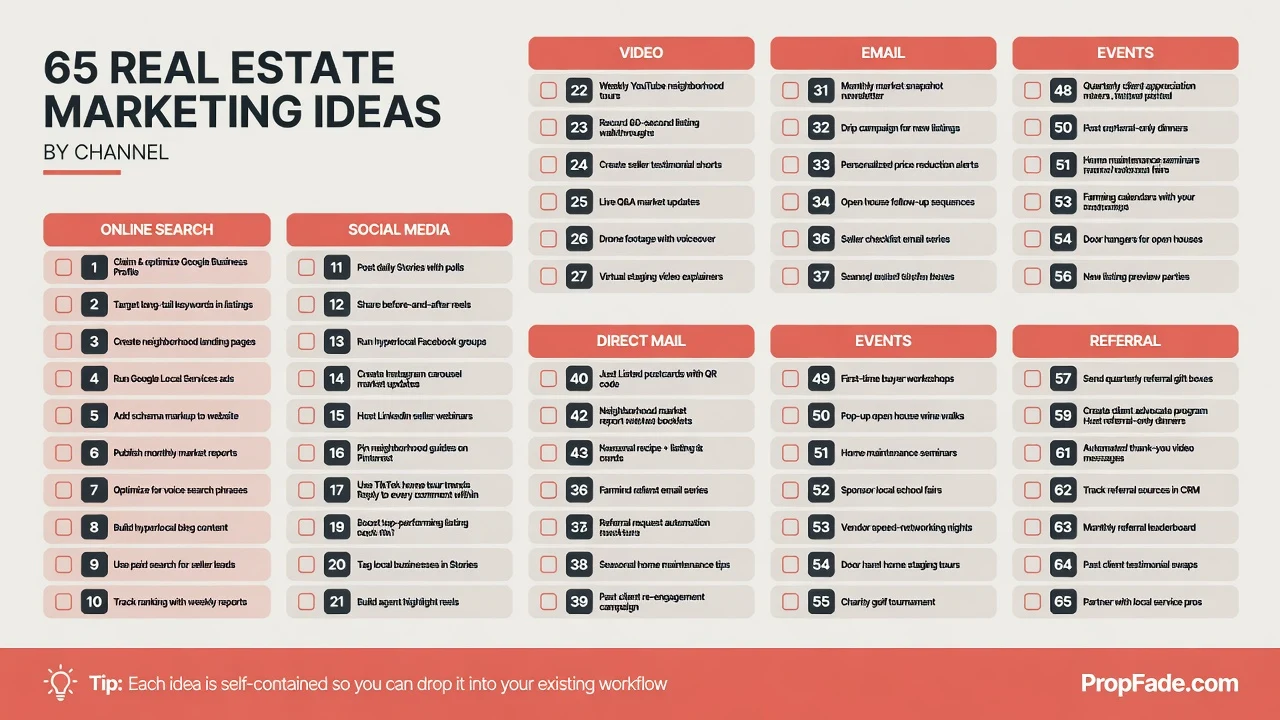
Online and search (ideas 1-10)
- Claim and fully complete your Google Business Profile: headshot, bio, service area, and at least 25 photos.
- Optimize your Zillow and Realtor.com profiles with a professional photo and a target of 25 or more verified reviews.
- Build one neighborhood landing page on your website for each area you actively serve.
- Run Google Local Services Ads on a pay-per-lead basis to appear above organic results for high-intent searches.
- Start a neighborhood market report blog updated every month with median prices, days on market, and absorption rate.
- Add a home value estimator widget to your homepage so visitors can self-qualify before contacting you.
- Build a “just sold” gallery page that shows your track record with photos, addresses, and sale-to-list ratios.
- Create a first-time buyer resource hub with a checklist, a mortgage glossary, and a step-by-step buying guide.
- Set up Google Display retargeting so visitors who viewed your listings see your ads on other sites.
- Add local business schema and listing schema markup to every property page on your site.
Social media (ideas 11-20)
- Post a Reel or TikTok for every new listing, keeping each clip under 60 seconds.
- Share a “just sold” Story within 24 hours of closing while the moment is fresh.
- Go live on Facebook or Instagram during open houses and let viewers ask questions in real time.
- Post a monthly market update video directly to your feed with three local data points.
- Record a “day in the life” Reel that shows your process, not only your listings.
- Share a client testimonial video after every closing. A 30-second phone clip is enough.
- Post before-and-after staging photos in a side-by-side format.
- Use Instagram Stories polls to boost reach (“Would you live here?” or “Guess the list price”).
- Pin your best-performing listing Reel to the top of your profile.
- Repurpose one shoot to Facebook, Instagram, TikTok, and YouTube Shorts on the same day.
For cadence and platform strategy, the real estate social media marketing guide maps a full weekly posting schedule for agents.
Video (ideas 21-30)
- Make a listing tour video for every property you take to market.
- Record a neighborhood walkthrough: the coffee shop, the park, the school, not just the house.
- Film a 30-second “meet the agent” intro video for your bio page and your email signature.
- Create a five-part buyer FAQ video series answering the questions you hear every week.
- Produce a local market update video every month and post it to YouTube and Instagram.
- Record client success stories on camera at or immediately after closing.
- Make a “what $600k buys in [neighborhood]” comparison video that shows three properties side by side.
- Film a behind-the-open-house vlog to show preparation, turnout, and results.
- Create a short video for each buyer persona: first-timers, upgraders, and downsizers.
- Auto-render listing videos from MLS photos using a photo-to-video tool when filming is not practical.
For finished examples across property types, the real estate video hub covers formats, lengths, and per-platform best practices.
Email (ideas 31-40)
- Send a weekly or biweekly market update newsletter with new listings, price reductions, and recent sold prices.
- Build a seven-email drip sequence for new leads that runs over 30 days.
- Email a “just listed” announcement to your entire database the morning a property hits the MLS.
- Send a “just sold” recap with context: what drove the price, how many offers, and days on market.
- Deliver a personalized home value estimate to every past client once a year.
- Create a monthly neighborhood market report and gate it behind an email signup to grow your list.
- Send a seasonal homeowner checklist (spring prep, winterizing) to every homeowner in your database.
- Build a six-month nurture sequence for buyers who said they are not ready yet.
- Personalize subject lines with the recipient’s neighborhood or their home purchase anniversary date.
- Segment your list into three groups: active buyers, active sellers, and past clients, for targeted sends.
For templates and subject-line examples, the real estate email marketing guide provides a ready-to-send starting set.
Direct mail (ideas 41-48)
- Send a “just listed” postcard to every address within a 500-home radius the day a listing goes live.
- Mail a “just sold” card to the same farm immediately after closing to reinforce your name.
- Deliver a quarterly market report mailer to your geo-farm with three data points from the past 90 days.
- Send a seasonal greeting card to every past client in November or December.
- Mail a door hanger when you list or sell in a neighborhood to announce the result to immediate neighbors.
- Use Every Door Direct Mail (EDDM) to introduce yourself when you enter a new farm area.
- Send a handwritten thank-you note within 48 hours of every closing.
- Mail a “thinking of selling?” card to your geo-farm every 90 days to build top-of-mind recognition.
Events and community (ideas 49-55)
- Host a buyer seminar at a local coffee shop, library, or your office with a lender co-presenting.
- Hold a themed open house: twilight showing, catered preview, or a neighborhood block-party format.
- Sponsor a local 5K run, charity auction, or school fundraiser and include your brand on all materials.
- Host an annual client appreciation party for every buyer and seller you have ever closed with.
- Partner with a lender for a “buying in 2026” workshop and promote it to both contact lists.
- Attend Chamber of Commerce or BNI events monthly and focus on relationships, not immediate leads.
- Host a first-time buyer Q&A on Zoom, record the session, and post it to your YouTube channel.
Referral and sphere (ideas 56-65)
- Create a referral program with a thoughtful closing gift for every client who sends you a friend.
- Partner with movers, stagers, and contractors who serve the same clients you do and exchange introductions.
- Send a “one year in your home” anniversary card to every past client each year.
- Build a vendor referral list of local service providers and give it to every buyer at closing.
- Ask every satisfied client for a Google review within one week of closing while the experience is fresh.
- Call your sphere of influence twice a year with a genuine check-in, no ask attached.
- Join a local Facebook or Nextdoor group and contribute market data with no pitch.
- Co-market with an agent in a feeder market who sends you their relocating clients.
- Partner with a corporate relocation specialist or an HR benefits department in a major local employer.
- Send a congratulations note when you see a contact announce a promotion, a new baby, or a move.
Real estate marketing quick wins vs. long plays
Quick wins return results in days or weeks; long plays compound over months and years. Posting a listing Reel, emailing your database, or mailing a “just sold” card delivers a fast result. Geo-farming, a neighborhood blog, and a YouTube channel build over time.
Use this channel cheat sheet to map effort level, startup cost, and average time to first result so you can choose rationally.
| Channel | Effort | Startup cost | Time to first result | Fastest useful move |
|---|---|---|---|---|
| Online search | Medium | Low to moderate | 2 to 6 months | Complete your Google Business Profile and request five reviews |
| Social media | Low | Low | Same week | Post a listing Reel or just-sold Story from assets you already have |
| Video | Medium | Low to moderate | Same day to 2 weeks | Turn listing photos into a 30-to-60-second property tour |
| Low | Low | 1 to 2 weeks | Send a just-listed, just-sold, or market-update email to your database | |
| Direct mail | Medium | Moderate | 2 to 6 weeks | Mail a just-sold postcard to the same farm after every closing |
| Events | High | Moderate | 2 to 8 weeks | Host a focused open house, buyer seminar, or client event |
| Referral and sphere | Medium | Low | 1 to 6 months | Call your sphere with a genuine check-in and request timely reviews |
The fastest wins use materials you already have. A “just sold” postcard needs one photo, a price, and an address. A listing Reel needs the phone already in your pocket. Start with what costs you only time.
Long plays need consistency more than budget. Geo-farming requires three to four touches before a homeowner registers your name. A neighborhood blog takes several months before Google surfaces it. Budget one fixed hour per week for the long-play channel you choose, and protect that block.
Mixing quick wins with at least one long play gives you present results while a compounding asset builds in the background.
Real estate marketing ideas that scale with AI video and captions
AI tools convert listing photos into a published listing video with no filming required. A photo-to-video app animates 12 to 20 stills with motion, generates captions for sound-off viewing, and exports the three formats that cover every platform: 9:16 for Reels and TikTok, 1:1 for the feed, and 16:9 for YouTube and the listing page. Add a short voiceover recorded from the listing facts and the video is ready to post the same afternoon as the photo shoot.
This path covers ideas 21 through 30 from the video channel, especially for vacant homes, bad-weather listings, or a batch of ten properties at once. The ai real estate video editor walks through the complete photo-to-video workflow and compares the tools that handle each step.
AI caption tools apply the same principle to social copy. Draft one version of a listing caption, then use a text AI to rewrite it for Instagram, Facebook, and LinkedIn in under a minute. The real estate social media marketing guide includes a repeatable caption-writing workflow.
Video is the highest-leverage channel for most agents because one shoot, or one photo set, produces content for every other channel: social posts, email header images, website hero, and a YouTube upload. Run idea 30 once and you have a week of posts across four platforms.
Real estate marketing ideas matched to agent type, niche, and budget
The right starting ideas depend on your stage and budget. A new agent with $200 and a new luxury specialist with an established book both benefit from this list, but different corners of it.
New agent, low budget: Focus on ideas 11, 15, 31, 56, 60, and 61. Social media, a warm email to your personal network, and direct phone calls to your sphere cost nothing and build early momentum. Add idea 42 (just-sold postcard) on your first closing.
Established agent farming a neighborhood: Ideas 41 through 48 form your core. Run a 90-day mail cycle to a 500-home farm, track which conversations convert, and layer in a neighborhood blog (idea 5) after the first six months.
Luxury specialist: Ideas 22, 26, 50, and 63 differentiate at the luxury level. A neighborhood walkthrough video, a client story video, an invitation-only open house, and a co-marketing arrangement with a feeder-market agent all signal the service level luxury buyers and sellers expect. For additional approaches, unique real estate marketing ideas covers tactics suited to premium price points.
Team lead or broker: Ideas 52, 53, 54, and 63 build brand at scale. Client appreciation events, lender workshops, and co-marketing partnerships generate referrals that individual agents on the team convert.
Commercial agent: Ideas 2, 3, 9, 25, and 53 translate well to commercial. Profile optimization, retargeting, a monthly market update video, and a lender or CPA workshop all serve the longer commercial buying cycle.
For unconventional ideas beyond this list, creative real estate marketing ideas covers approaches for agents who want to stand out in a crowded market.
Common real estate marketing mistakes and how to fix them
Five mistakes account for most wasted marketing spend among real estate agents. Each has a one-sentence correction.
Posting without a call to action. A listing Reel that ends without direction loses the inquiry. Add “link in bio to book a showing” or “DM me for the address” to every post.
Farming an area once and stopping. One mailer produces almost nothing. Direct mail works through repetition: a homeowner needs to see your name three to four times before they associate you with the neighborhood. Commit to at least four touches per year before evaluating results.
Buying cold leads instead of building a warm database. Purchased leads cost more and convert at lower rates than past clients or warm referrals. Close a transaction, add the client to your drip sequence (idea 32), and market to that warm contact for years.
Filming vertical and exporting horizontal. A 9:16 Reel cropped to 16:9 for YouTube cuts off the frame and looks unprofessional. Film one project and export each format natively, or use a tool that handles per-platform sizing automatically.
Sending email inconsistently. A database that hears from you twice a year treats you as a stranger. A database that hears from you every two weeks treats you as the agent they already know. Block 30 minutes per week for your newsletter and protect that time the same way you protect a showing.
Marketing ideas for your niche and season
Generic campaigns lose to campaigns built for one audience, and the niche guides hand you that targeting ready-made. On the property side, luxury marketing ideas cover the restraint and production standard high-end sellers expect, commercial marketing ideas speak to tenants and investors rather than families, condo marketing ideas sell the building alongside the unit, new construction marketing ideas handle pre-sales from renderings, and waterfront marketing ideas lead with the setting buyers are really paying for. Outside the metro, rural marketing ideas reach buyers searching by acreage and lifestyle rather than commute.
Audience-specific situations get their own playbooks. First-time buyer marketing ideas build the education-first funnels that convert nervous renters, investor marketing ideas lead with numbers and deal flow, and downsizer marketing ideas respect the emotional weight of a decades-long home. For transition-driven sellers, divorce marketing ideas and probate marketing ideas cover the sensitivity and process knowledge those listings demand, military relocation marketing ideas work the PCS calendar around installations, and the prospecting-adjacent pair of expired listing marketing ideas and FSBO marketing ideas target the two seller groups every agent already knows how to find.
Seasonal campaigns work because timing supplies the hook. Walk the calendar with spring, summer, fall, and winter marketing ideas, each tuned to that season’s inventory rhythm, then layer holiday marketing ideas for the community-goodwill window and New Year marketing ideas for the resolution-driven surge of January buyers. When you want campaigns nobody else in your market runs, the unique marketing ideas collection is the pattern-breaker list.
Strategy, plans, and the templates that run them
Tactics without a plan burn budget in random directions. The real estate marketing strategies guide covers the channel-mix decisions that precede any spend, the marketing strategy examples page shows complete worked programs you can model, and the best marketing types comparison ranks channels by cost and conversion so the mix starts from evidence. From there, the real estate marketing plan guide walks through building the quarterly plan itself, and the marketing plan template gives you the six-section fill-in structure with a worked example.
Execution lives in the supporting templates. The real estate marketing checklist converts the plan into pre-listing, launch-day, and weekly tasks, the marketing management template tracks spend and cost per lead across channels, and the marketing templates library covers the flyer, email, and social formats a listing campaign reuses every time. For the habits that keep all of it running, the real estate marketing tips collection is the per-channel fundamentals refresher.
Listing descriptions and copy that convert
The written listing is still the asset every portal indexes first. Start with the real estate description guide for the four-part structure, then use writing real estate descriptions for the room-by-room formulas and power-word choices that separate specific copy from filler. To calibrate by example, the 30 listing description examples span every property type, the best descriptions breakdown annotates why top performers work, and the creative description examples collection covers seven distinct styles for listings that deserve more than the standard template.
Two guides handle the production shortcuts. The SEO listing description guide shows how keyword placement in the first sentence wins portal search filters, and the listing description guide covers prompt-assisted drafting, source-fact checks, and the fair-housing review pass that make AI drafts publishable.
Print marketing: flyers, brochures, postcards, and signs
Print still closes the loop at open houses and in geographic farms. The real estate flyers hub covers the four campaign types every listing cycles through, how to create a real estate flyer is the step-by-step build, and the flyer template library maps the editable layouts by listing stage. Design questions route to the flyer design guide for hierarchy and typography rules, the flyer ideas collection for all 12 use cases, the flyer examples breakdown for annotated finished pieces, and the flyer template library for the browser tools that do the assembly.
Beyond the flyer, the brochure templates guide covers the multi-page formats luxury listings expect, the direct mail guide builds the geo-farm program with response math, the postcard templates guide handles the highest-frequency mail format, and the yard signs guide covers panel specs, vendors, and the QR placement that turns drive-by attention into clicks.
Photography, staging, and visual media
Every other asset inherits its quality from the photo set. The real estate photography tips guide covers the 27 gear, settings, and composition moves that produce listing-grade images, the photography checklist sequences the shot list room by room, and the photography examples page shows good-versus-bad pairs so you can self-grade. When you would rather not shoot, the hire a photographer guide benchmarks costs by market tier and lists the pre-booking questions, and the photo editing guide compares DIY software against done-for-you services for the post-shoot pass.
Two visual upgrades extend the photo set. The virtual staging guide furnishes vacant rooms digitally with the MLS disclosure rules attached, and the virtual tour guide covers 3D walkthroughs for out-of-town buyers.
Digital, email, and text channels
The digital core deserves its own system. The digital marketing guide assembles the full online program, the digital marketing ideas list supplies channel-by-channel tactics including retargeting, and the digital marketing strategies guide shows how video, social, and search compound instead of competing. On the owned-audience side, the email marketing guide builds the four automated sequences, the email templates library gives you five copy-paste campaign messages with subject-line swipe files, and the email ideas collection fills the calendar with 30 nurture, reactivation, and promotional angles. For the most direct channel of all, the text message marketing guide covers SMS scripts and the TCPA consent rules that keep the program legal.
Paid ads and search visibility
Paid and organic search put you in front of buyers at the moment of intent. The Google Ads guide builds the campaign structure, match types, and landing pages that keep cost per lead sane, and the Facebook ads guide covers the targeting and creative formats that still work under current ad-category rules. On the organic side, the real estate SEO guide covers keywords, technical basics, and content cadence, the local SEO guide wins the map pack through your Google Business Profile and reviews, and the SEO keywords list hands you the buyer, seller, and neighborhood terms to build pages around.
Events, presentations, and lead capture
In-person moments convert the demand the other channels create. The open house ideas guide covers 27 promotion, on-site, and follow-up tactics that turn attendance into offers. For the seller side of the table, the realtor listing presentation guide walks the appointment minute by minute, the listing presentation template provides the 15-slide structure with talk-track script, and the listing presentation examples page breaks down five winning deck formats. Behind all of it, the how to get leads guide maps the capture systems that make sure no inquiry from any of these channels falls through.
Build a real estate marketing plan from this idea list
Pick six ideas from the list, two from separate channels, and commit to running all six for 90 days before adding more. A short plan you execute consistently outperforms a long plan you follow for two weeks.
Map the six ideas to a weekly calendar. Video and social take the most time, so batch-film on one morning per week and schedule the posts in advance using a scheduling tool. Email takes about 30 minutes once you have a repeatable template. Direct mail is a monthly task once you set up the vendor relationship.
Track one metric per channel: post reach for social, open rate for email, and listing inquiries sourced from direct mail. After 90 days, double down on the channel with the strongest result and replace the weakest idea with a new one from the list.
For a complete year-round strategy, the real estate marketing pillar hub links to channel-specific guides for social, video, email, and listing marketing covering every segment of the plan.
Frequently asked questions
The highest-impact ideas combine listing video for social (Reels, TikTok, Shorts), a consistent biweekly email to your database, and direct mail to a geo-farm every 90 days. Start with one idea per channel and add more after 30 consistent days.
Realtors build visibility through a Google Business Profile, social media video, a regular email newsletter to their database, direct mail to a farm area, and referral partnerships with past clients and local businesses. Consistent agents in fewer channels tend to outperform inconsistent agents spread across all of them.
The best marketing depends on your stage and budget. New agents with limited budgets see the fastest return from social media video, warm outreach to their sphere, and Google review requests after every closing. Established agents with a database typically get strong returns from email marketing, geo-farm direct mail, and listing video production.