Local SEO for real estate helps agents appear in Google’s map-based results when buyers or sellers search by city, neighborhood, or “near me.” Ranking in those results places your name above the standard organic listings, where most location-intent clicks go.
This guide covers the full playbook: Google Business Profile optimization, neighborhood landing pages, review strategy, citation building, and the four mistakes that keep most agents off the map. Follow the sections in order and you have a repeatable local SEO system.
Why the Google Map Pack matters for real estate agents
The Google Map Pack is the three-business listing that appears above organic results for local queries like “real estate agent in Austin” or “realtor near me.” Agents in those three positions capture the majority of local-intent clicks before a buyer or seller scrolls to the organic results below.
Local real estate searches are driven by hyper-specific intent. A buyer who types “homes for sale Buckhead Atlanta” or “real estate agent [city]” has already decided to buy or hire, which makes these searches far more valuable than broad informational queries. City-neighborhood keyword combinations tend to carry lower competition scores than broad real estate keywords, meaning a well-optimized agent can build rankings with consistent effort over time.
The map pack ranks on three signals: relevance (how well your profile matches the query), distance (how close your business address is to the searcher), and prominence (your reviews, citations, and overall online authority). Each signal is something you can directly improve.
Near-me searches on mobile have grown significantly, and real estate is one of the top categories where buyers and sellers act on them. The agent who appears in the map pack at that moment is the one who gets the call.
Local SEO authority compounds over time. A stronger citation profile supports prominence, which in turn supports map-pack position and earns more profile views over time. Track GBP calls, direction requests, and website clicks monthly to see how these inputs move measurable outcomes. The broader real estate seo guide covers the on-page keyword and link strategy that works alongside these local signals.
Optimize your Google Business Profile in seven steps
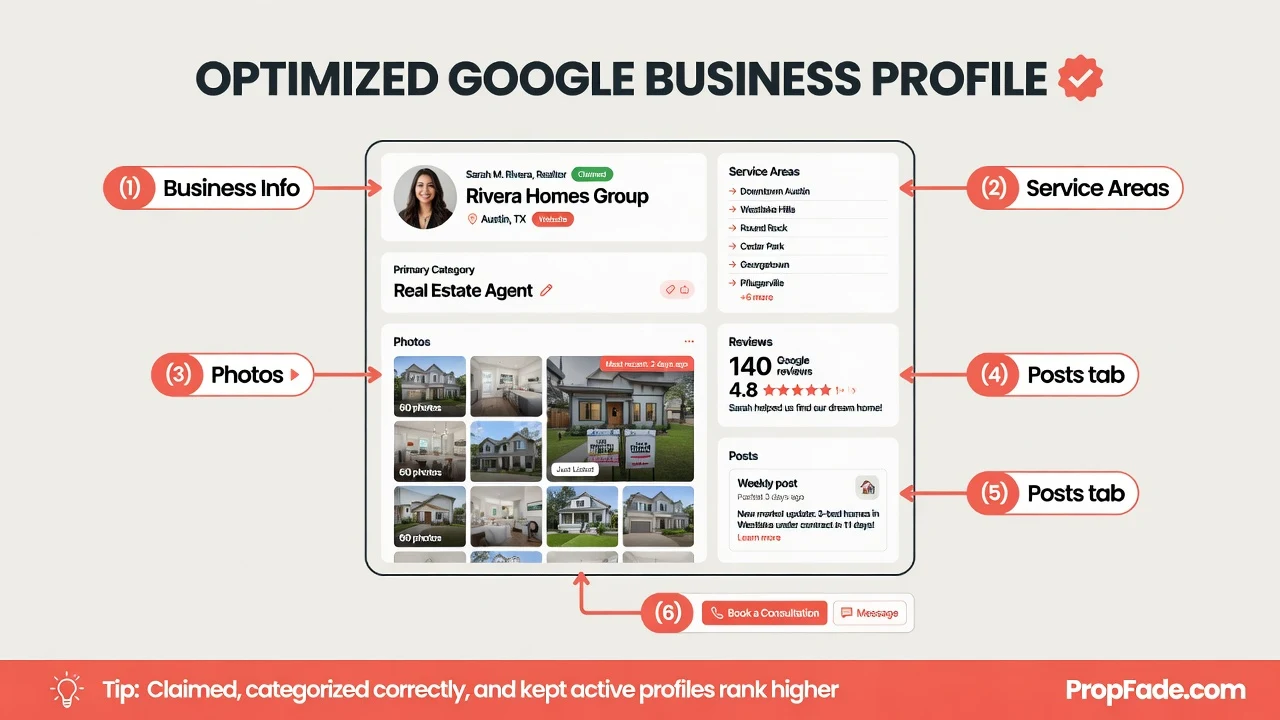
Completing your Google Business Profile is the single highest-leverage local SEO action for an agent. Profiles that are claimed, categorized correctly, and kept active rank substantially higher in the map pack than sparse or unclaimed listings.
Follow these steps to build a profile that ranks:
- Claim or create the profile. Go to business.google.com and search for your name. If a profile already exists from a previous brokerage, request ownership before creating a new one. Two active listings for the same person suppress both.
- Set the primary category to “Real Estate Agent.” If you also handle commercial properties or property management, add those as secondary categories. The primary category is the most important single ranking signal Google reads from a GBP.
- Write a complete, keyword-rich description. Use the full 750-character limit to describe who you serve, which neighborhoods and cities you cover, your years of experience, and your specialties. Include the city name and “real estate agent” naturally in the first two sentences.
- Add at least 20 photos and continue adding them monthly. Upload a professional headshot or office exterior, listing photos from recent closings, and neighborhood shots that show the communities you serve. Profiles with more photos consistently receive more views and direction requests. Add two to four photos per month to signal an active business.
- List your service areas explicitly. Use the service-area field to name every city, neighborhood, or ZIP code where you actively work. You can add up to 20 service areas. Service areas signal relevance and profile completeness, but your verified office address still anchors proximity. To build genuine visibility in neighborhoods farther from your office, pair each service-area entry with a dedicated neighborhood page, reviews that name the area by city or ZIP, and local directory citations that confirm your presence there.
- Add a tracked phone number, appointment link, and complete services list. Set a direct booking or contact page URL in your profile, keep your hours current, and list the services you offer. Establish a clear response SLA for calls, form submissions, and SMS leads so that every profile visit has a direct path to a conversation.
- Post a weekly update. GBP posts (under the “Update” tab) signal an active business. Post a just-listed photo, a local market stat, or a neighborhood tip each week. Agents who post weekly tend to see stronger engagement metrics than those who post irregularly.
Build neighborhood landing pages that rank for local searches
A neighborhood landing page targets a single city or community, such as “Homes for Sale in Midtown Atlanta” or “East Nashville Real Estate.” These pages rank for hyper-local queries that Google map results miss and earn organic clicks from buyers deep in the decision process.
Write 800 to 1200 words per page. Include recent sales data (median price, days on market, price per square foot from your own closings), objective school information such as district boundaries and links to official district websites, commute distances to major employers, and a lifestyle description naming the coffee shops, trails, restaurants, and recreation centers buyers will actually recognize. Keep all school references factual, sourced, and neutral; share data consistently across all buyers to stay within HUD’s fair housing guidelines. Buyers searching at this level are close to making a decision and respond to concrete details.
Each page should target one primary keyword, usually “[neighborhood] real estate” or “homes for sale in [neighborhood],” with a handful of secondary variants. City-neighborhood combinations tend to have lower competition than broad market keywords, and a well-written page on an established domain can gain meaningful traction within weeks to a few months, depending on market size and your domain’s existing authority.
Structure each page consistently so readers know what to expect: a hero image or map embed at the top, a brief neighborhood overview in the first paragraph, a recent-sales data block, school information, commute notes, and a contact or property-search CTA at the bottom. Consistent structure also lets you build pages faster across multiple communities.
Link every neighborhood page back to your city hub and out to your GBP profile. This internal linking signals to Google that your site is the local authority for that area, reinforcing the same prominence that the map-pack algorithm rewards. The best seo keywords for real estate guide covers the keyword patterns that work for each neighborhood-page format.
Build five pages first, covering the markets where you have closed the most deals. A real statistic from one of your own closings, such as “The average home sold in this neighborhood spent 11 days on market last quarter,” is the fastest way to differentiate your page from the generic versions on aggregator sites.
The real estate marketing ideas hub covers how neighborhood content fits into a broader marketing program, alongside social, email, and video.
Turn neighborhood content into video proof assets
Neighborhood pages and GBP posts work harder when they include video. A short market-update or listing walkthrough embedded on a neighborhood page gives buyers a reason to stay longer and creates a shareable asset for your weekly GBP posts.
A slideshow video editor turns property photos into animated listing videos in three formats: 9:16 for Reels and Stories, 1:1 for feed posts, and 16:9 for website embeds and YouTube, with a short voiceover and captions carrying the market facts.
For local SEO the workflow is straightforward: take photos from a recent closing in the target neighborhood, build a short market-update video, embed the 16:9 version at the top of the neighborhood landing page, and post the 9:16 cut as your weekly GBP update. The video transcript adds indexable text to the page and the embed increases the time visitors spend on it.
Agents who document recent work in a specific area with video have a concrete proof-of-presence asset to add to neighborhood pages, citation listings, and review requests. That combination strengthens all three map-pack factors: relevance through keyword-matched content, proximity through documented neighborhood activity, and prominence through engagement signals.
Common local SEO mistakes real estate agents make and how to fix them
Most agents who do not rank locally share one of five problems: an incomplete GBP, a duplicate listing, NAP inconsistency, no neighborhood content, or keyword mismatch. Each has a specific fix.
Incomplete GBP. The profile is claimed but half the fields are empty, the photo count is under five, and there are no posts or service areas. Fix: schedule two hours to complete every field, upload 20 photos, and set a recurring calendar reminder to post weekly.
Duplicate listings. When an agent moves brokerages, or a brokerage creates a profile on the agent’s behalf, two listings exist for the same person. Google suppresses both. Fix: search your name in Google Maps, claim every profile you find, and request removal of duplicates through GBP support chat.
NAP inconsistency. Your name, address, and phone appear differently across directories: “Suite 100” on your site, “Ste 100” on Yelp, and no suite number on Realtor.com. Google treats each variation as a different entity, diluting your authority. Fix: audit your citations with a tool like Moz Local or Whitespark, then correct the top 20 mismatches.
No local content. A website with generic “buying” and “selling” service pages gives Google nothing specific to match against a neighborhood query. Fix: create three to five neighborhood pages using the structure in the section above.
Keyword mismatch. Optimizing for “best realtor in [city]” (how a competitor describes you) misses the actual buyer search, which is “[city] homes for sale” or “[neighborhood] real estate agent.” Use the terms buyers type, based on real keyword data. The real estate marketing strategies guide breaks down intent by query type.
Local SEO works best as part of a broader digital program. The digital marketing strategies for real estate guide covers how to coordinate local search with paid ads, social, and email.
Local SEO examples: what a well-optimized agent profile looks like
A well-optimized local agent profile combines a complete GBP, consistent citations across the major directories, a neighborhood content library, and an active review cadence. The result is visibility in both the map pack and organic results for the same buyer query.
Here is a concrete example. An agent serving three neighborhoods in a mid-size metro has:
- A claimed GBP with 60 photos updated monthly, 140 Google reviews averaging 4.8 stars, and weekly posts
- A website with seven neighborhood landing pages, each around 1000 words with recent sold data from the agent’s own closings
- NAP identical across Zillow, Realtor.com, Homes.com, Yelp, Facebook Business, and four local chamber and association directories
- A quarterly cadence of market-update blog posts, each interlinked to the relevant neighborhood page
- A Nextdoor presence in the same ZIP codes that reinforces name recognition, which the Nextdoor marketing guide for real estate agents covers in detail
That combination means the agent appears in multiple positions for a single buyer query: the map pack, the organic results for the neighborhood page, and sometimes the People Also Ask box for a related question keyword.
Compare that to an agent whose GBP has six photos, 12 reviews, and no service areas listed, whose website has one “I serve all of Metro [city]” page, and whose name appears with three different phone numbers across directories. That agent is invisible to the same buyer at the same moment.
| Profile element | Sparse profile | Optimized profile |
|---|---|---|
| Photos | Five to six photos with no recent upload pattern | 60 photos updated monthly, including listings and neighborhood shots |
| Reviews | Eight to twelve reviews with uneven detail | 140 reviews averaging 4.8 stars, with area and service mentions |
| Service areas | No service areas or one generic metro statement | Twelve service areas tied to neighborhood pages and citations |
| Posts | No weekly post cadence | A weekly update with a listing photo, market stat, or neighborhood tip |
| Category | Primary category missing or mismatched | Primary category set to Real Estate Agent |
| Website support | One broad service page | Seven neighborhood pages with recent sold data and internal links |
Earn reviews and citations to strengthen your local authority
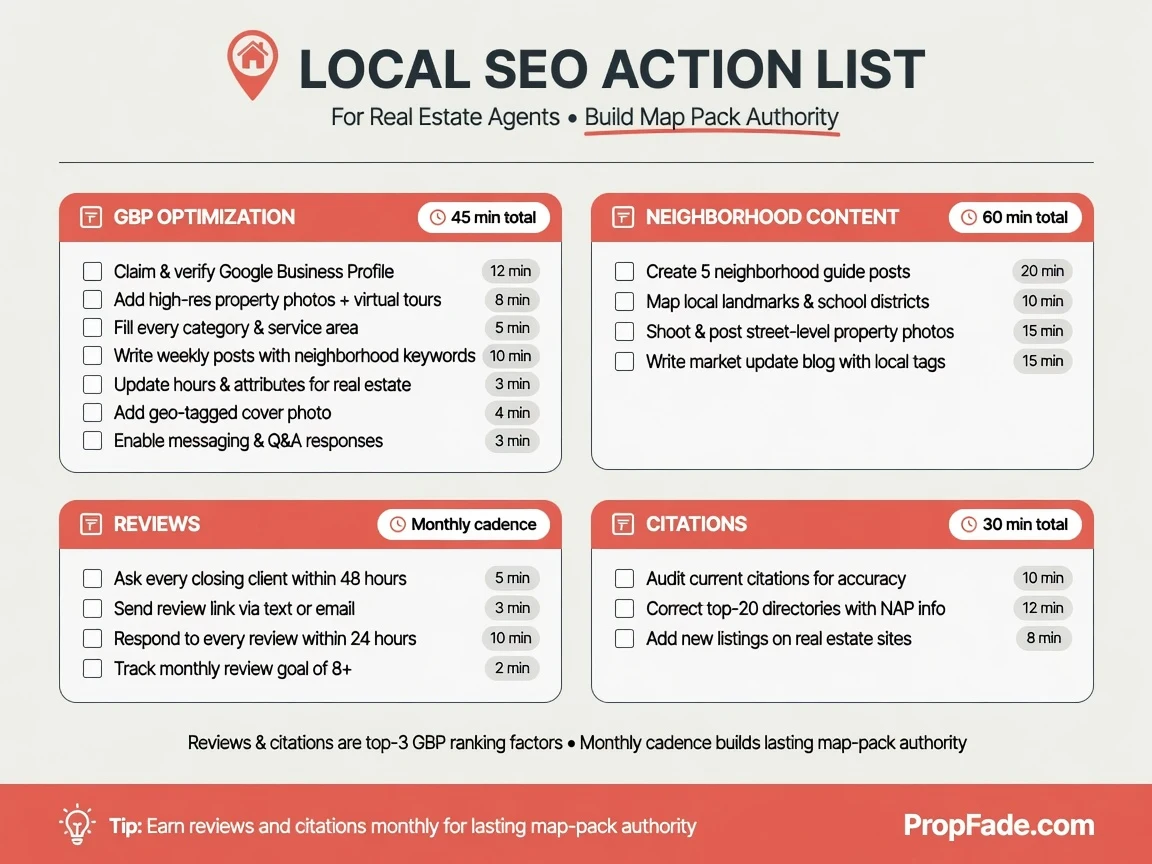
Reviews and citations are two of the top three GBP ranking factors, alongside relevance and distance. A repeatable monthly cadence for both compounds into lasting map-pack authority that holds without heavy ongoing effort.
Reviews. Ask every client for a Google review within 48 hours of closing, when the experience is fresh. Send a direct link to your GBP review page so the action is one tap for the client. A personal text message consistently outperforms a templated email for response rate. Aim for at least two new reviews per month at a minimum, and four to six per month for an active agent.
Respond to every review, including critical ones, within 48 hours. Google factors response rate into prominence scoring, and a thoughtful response to a negative review shows prospective clients how you handle difficult situations.
Citations. A citation is any online mention of your business name, address, and phone number. Start with the directories Google weights most heavily for real estate: Zillow, Realtor.com, Homes.com, Yelp, Facebook Business, and the National Association of Realtors member directory. Then add your local chamber of commerce and any neighborhood business or professional association directories.
After the core directories, audit for consistency with a tool like Whitespark or BrightLocal. The audit surfaces every directory where your NAP appears and flags mismatches. Correct the top 20 citations first, because the incremental benefit of additional citations decreases past that threshold.
A cadence of two new reviews and one citation correction per month, sustained over 12 months, builds the kind of authority that holds a map-pack position across query variations.
Frequently asked questions
Agents rank locally by claiming and fully completing their Google Business Profile, building neighborhood-specific landing pages on their website, earning Google reviews consistently, and maintaining identical name, address, and phone information across Zillow, Yelp, Realtor.com, and other directories. These three signals together determine map-pack position: relevance, distance, and prominence.
Local SEO for realtors is the process of optimizing your Google Business Profile, website content, and directory listings so you appear in location-specific search results when buyers or sellers search for an agent by city, neighborhood, or ZIP code. It targets the Google Map Pack, which appears above organic results for these queries.
To show up in the Google Map Pack, claim your Google Business Profile, set the primary category to Real Estate Agent, list your service areas, add at least 20 photos, and build a steady stream of Google reviews. Consistent NAP information across Zillow, Yelp, and other directories strengthens your prominence score, which is the third major ranking factor alongside relevance and distance.