Real estate SEO earns you organic rankings when buyers search for listings and sellers search for agents in your market. A complete program covers four areas: finding the right keywords, creating content that matches local search intent, maintaining your Google Business Profile, and getting the on-page technical basics right.
This guide walks each area in order, from keyword research through monthly maintenance. The 30-point checklist in the technical section gives you a one-page audit you can run on your own site today.
How real estate SEO works in 2026
Real estate SEO ranks your website and your Google Business Profile for searches buyers and sellers run in your market. Three signals drive rankings: relevance (your page matches the searcher’s intent), authority (credible third-party sites link to yours), and trust (consistent business information across directories).
Local results dominate real estate SERPs. When someone searches for “listing agent in [city]” or “homes for sale in [neighborhood],” Google surfaces a map pack, three local business listings, above the organic results. Your Google Business Profile controls that pack. Your website controls the organic rankings below it. A complete real estate SEO strategy works both levers at the same time.
AI Overviews appear on many informational real estate queries in 2026. An AI-generated summary can answer a general question without the searcher clicking through, which reduces traffic to generic how-to content. Pages with copy-paste assets (keyword starter lists, checklists, templates) still earn clicks because readers come for the working material itself, not the summary of it. That is why this guide leads with the assets.
For the broader content and channel picture, the real estate marketing ideas hub maps the full marketing program alongside SEO.
Keyword and content strategy for real estate agents
Effective real estate SEO keywords combine a location with a buyer or seller action. Hyperlocal terms carry the lowest competition (keyword difficulty 0 to 10 in most mid-sized markets) and the highest purchase intent.
The most consistent pattern is location plus action. “Homes for sale in [neighborhood],” “[city] listing agent,” “how to buy a home in [city],” and “[area] real estate market update” all follow this structure and rank well for individual agents because national portals rarely optimize at the neighborhood or ZIP-code level. That gap is your entry point.
A practical keyword strategy maps to three content types:
- Neighborhood and market pages targeting “[area] homes for sale” and “[area] real estate market” (one page per area you serve, optimized for a single ZIP code or neighborhood name)
- Buyer and seller guides targeting “[city] home buying guide,” “how to price a home in [city],” and “[city] first-time buyer checklist”
- Authority content covering local topics: school district summaries, market update reports, neighborhood spotlights, and local business roundups
Each page targets one primary keyword. Place it in the H1, the URL slug, the opening paragraph, and at least one H2. Internal links between your neighborhood pages and your guides pass authority through the site and help Google understand how pages relate to each other.
A consistent publishing cadence matters as much as keyword selection. Publishing two to four new or updated pages each month, a mix of neighborhood profiles, buyer guides, and market reports, compounds authority faster than publishing a large batch once and then stopping.
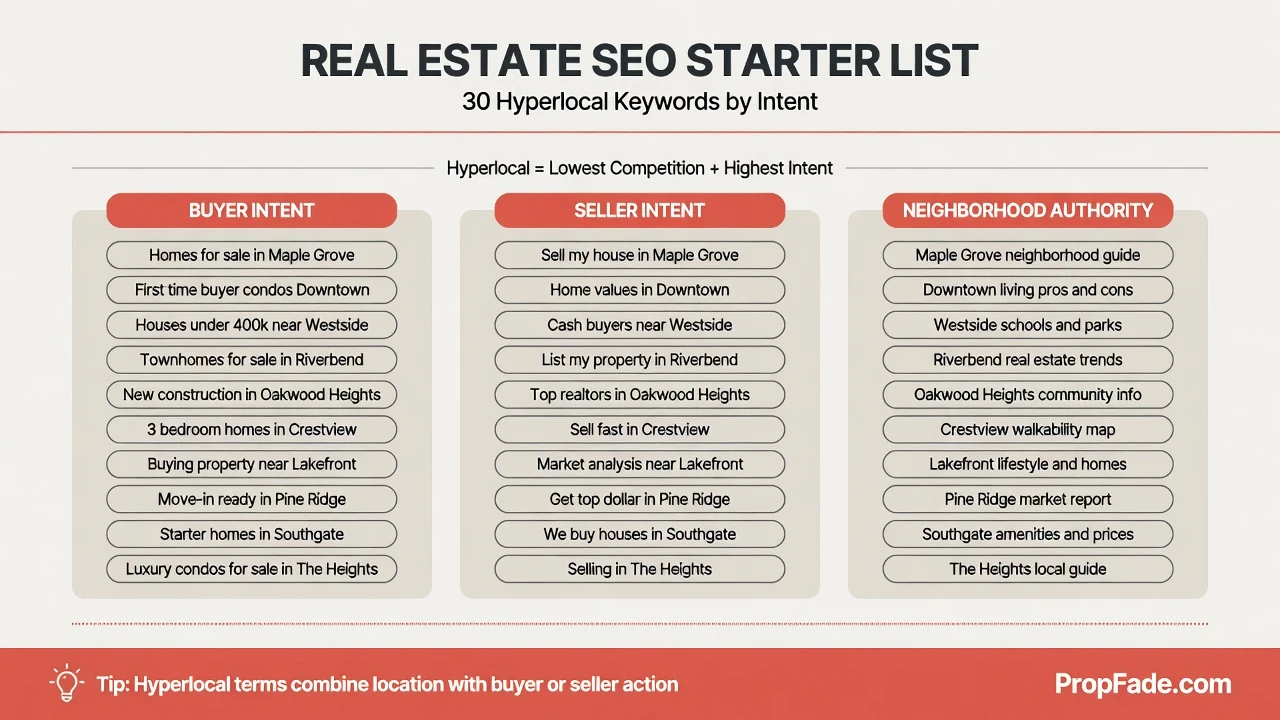
For a full breakdown of proven terms, the best seo keywords for real estate guide covers the complete cluster, segmented by intent and competitive tier, with ready-to-use keyword groups for common market types.
Video content earns a second traffic channel alongside organic search rankings. YouTube is the second-largest search engine, and neighborhood walkthroughs, listing tours, and market update summaries rank for the same local queries your website targets. A video embedded on its matching neighborhood page increases time on page, which reinforces the page’s relevance signal.
Practical video SEO tactics that compound with your keyword strategy:
- Neighborhood walkthroughs: title the YouTube video “[Neighborhood Name] [City] neighborhood tour [year]” to match how buyers search before visiting. Embed it on the matching neighborhood page.
- Monthly market updates: a “[City] real estate market update” video targets recurring searches and builds subscriber momentum over time.
- Animated listing videos: short animated property videos on listing pages increase time on page and give buyers a visual summary alongside the IDX data.
- Transcript reuse: paste a caption or transcript block below each embedded video. Google indexes the text, extending the page’s keyword coverage without a separate article.
A photo-to-video editor converts listing photos into animated property videos in three formats (9:16, 1:1, and 16:9) with voiceover and captions. The portrait format goes directly to Instagram Reels and YouTube Shorts; the landscape format embeds on neighborhood pages. Producing both from the same listing photos reduces the work of maintaining a video presence and an SEO-optimized property page at the same time.
The real estate digital marketing strategies guide covers how video, social, and SEO compound together into a single marketing program.
Local SEO and Google Business Profile for real estate agents
Local SEO for real estate puts your name in the map pack when buyers and sellers search for an agent in your area. Google ranks the local pack using three signals in combination: relevance (your GBP category, business description, and services match the query), proximity (your brokerage address is near the searcher), and prominence (reviews, backlinks, citations, website authority, and category consistency signal an established practice). Your Google Business Profile is the key interface for tuning relevance and prominence; your website authority reinforces prominence independently.
A complete GBP setup includes:
- A verified address that matches your brokerage office location
- Exact business name, phone number, and website URL, matching what appears on your website’s contact page precisely
- “Real estate agent” as the primary business category
- At least 20 photos: headshots, listing images, your office exterior, and neighborhood landmarks
- At least one post per week, particularly new listing announcements and market update summaries
Reviews are the strongest prominence signal within your control. The competitive threshold varies by market: check the top three listings in your local pack and note their review counts, average ratings, and how recently reviews were posted. Recency weighs as much as total volume in Google’s algorithm, so consistent review generation over time outperforms a one-time burst. Request a review from every closed client within 48 hours of closing, while the experience is fresh.
Responding to reviews (both positive and critical) signals an active business to Google and to prospective clients. A brief, specific response to a 5-star review (“Thank you for trusting me with the sale of your Northbrook home”) performs better than a generic one.
Citations reinforce your GBP. A citation is your business name, address, and phone number listed on a third-party site. Key citation sources include Yelp, your brokerage agent directory, Zillow agent profile, Realtor.com profile, local chamber of commerce pages, and neighborhood association websites. Keep the name, address, and phone number identical across every directory.
Local press and community links also contribute to your local authority. A mention in the neighborhood newsletter, a sponsorship page from a youth sports league, or a quote in a local business story each carry a backlink that reinforces your geographic relevance.
The local seo for real estate guide walks through GBP setup, review strategy, and citation building in a step-by-step format.
Technical and on-page SEO basics: the checklist
Technical SEO for real estate websites covers five areas: page speed, mobile rendering, HTTPS, structured data, and crawlable URLs. Agents on hosted platforms (Placester, Squarespace, Wix) get most of these by default; agents on custom builds should verify each with Google Search Console.
On-page basics apply to every page you publish:
- One H1 containing the target keyword
- Meta title under 60 characters
- Meta description under 155 characters, including the location and the value the page offers
- At least two internal links connecting the page to related pages on your site
- Images with descriptive alt text naming the property or the neighborhood
Schema markup tells search engines what your page represents. Add RealEstateAgent or LocalBusiness markup to your homepage and agent bio pages. Many IDX platforms add RealEstateListing schema to property pages automatically; check your platform settings or view the page source to confirm it is present.
Page speed matters on mobile, where the majority of real estate searches originate. Google’s page experience ranking signal uses Core Web Vitals field data collected from real visitor sessions: LCP (Largest Contentful Paint, target under 2.0 seconds), INP (Interaction to Next Paint, target under 200 milliseconds), and CLS (Cumulative Layout Shift, target under 0.1). Run a Google Lighthouse audit to identify problems to fix, then verify your actual standing in the Core Web Vitals report inside Google Search Console, which reflects real-user data across your site’s pages. For real estate sites, the most common culprits are uncompressed listing photos, IDX scripts that delay mobile load, and above-the-fold images loaded without fetch-priority hints. Compress listing photos before uploading (target under 200 KB per image) and defer any scripts that are not needed on the first screen view.
Real estate SEO audit checklist
- GBP setup: verify the address, exact business name, phone, website URL, and primary category.
- GBP photos: upload at least 20 photos across headshots, listing images, office exterior, and neighborhood landmarks.
- GBP posts: publish at least one listing or market update post per week.
- Reviews: request every closing review within 48 hours and respond to every review.
- Citations: keep name, address, and phone identical across Zillow, Realtor.com, Yelp, brokerage, chamber, and local directories.
- On-page basics: use one keyword-focused H1, a short meta title, and a location-aware meta description.
- Internal links: add at least two related internal links on every page.
- Images: compress listing photos and write descriptive alt text naming the property or neighborhood.
- Schema: confirm RealEstateAgent, LocalBusiness, or listing schema where your platform supports it.
- Maintenance: review Search Console, GBP views, keyword positions, review collection, and citation accuracy on schedule.
Measure and maintain your real estate SEO
Real estate SEO compounds when you track three numbers monthly: organic sessions in Google Search Console, keyword ranking positions for your core terms, and conversions from organic visitors (form fills, calls, and appointment bookings).
Ranking timelines vary by competition and site age. Most agent sites see measurable movement on local and agent-name terms within three to six months. Competitive city-wide or metro-level keywords take six to twelve months or longer. New sites take more time; sites with existing backlinks or domain age rank faster on new pages.
| Metric | Where to track it | Cadence |
|---|---|---|
| Organic sessions | Google Search Console | Monthly |
| Keyword positions | GSC Performance tab or a rank tracker | Monthly |
| Click-through rate | Google Search Console | Monthly |
| GBP profile views | GBP Insights dashboard | Monthly |
| New reviews collected | GBP dashboard | Weekly |
| Citation accuracy | Manual spot-check across key directories | Quarterly |
Link building for real estate focuses on a short list of high-return activities: directory citations, links from your brokerage agent directory page, local press mentions, neighborhood blog features, and community sponsorship pages. Each external link tells Google that a third party endorses your authority in a specific geographic market.
Updating existing pages produces results alongside publishing new ones. A neighborhood page that ranked on page two last quarter can move to page one after you add a current market stats section, a recent listing example, and two new internal links pointing to it. Search engines re-crawl and re-rank updated content, so a 30-minute update can outperform a new page that takes three hours to write.
The real estate marketing tips page has a prioritized action list for agents who are short on time, and the real estate marketing strategies guide lays out a 90-day content and SEO calendar you can run without an agency.
Frequently asked questions
Real estate agents build SEO through three activities: creating hyperlocal content (neighborhood pages, buyer guides, and seller guides) targeting searches specific to their market; optimizing and actively maintaining a Google Business Profile with photos, posts, and review responses; and earning citations and links from local directories, brokerage pages, and local press. The combination of content, GBP, and authority signals drives both map-pack and organic rankings.
SEO works for real estate agents, particularly at the local and hyperlocal level where national portals compete less aggressively. Agent-name searches, neighborhood queries, and city-level buyer and seller guides all return results that individual agents can rank for with consistent publishing and GBP maintenance. The lower the competition in your specific market, the faster you see results.
Real estate SEO typically shows measurable ranking movement within three to six months for local and agent-name terms. Competitive city-wide or metro keywords take six to twelve months or longer. New sites take more time; sites with existing backlinks or domain age rank faster on new pages. A consistent monthly publishing cadence of two to four pages accelerates the timeline.
The most effective real estate SEO keywords combine a location with a buyer or seller action. Examples include homes for sale in a specific neighborhood, city listing agent, how to buy a home in a city, and area real estate market update. Hyperlocal terms at the neighborhood or ZIP-code level carry the lowest competition and convert at the highest rate because the searcher has already named the market they want.