
Real estate Facebook ads give agents a direct channel to in-market buyers and sellers, with geographic targeting and lead form design that surface qualified buyers and sellers in your market. A well-structured campaign captures leads directly inside Facebook, routes them to your CRM, and runs on a modest daily budget.
This guide covers each part of the setup: choosing the right objective, building audiences that work inside Facebook’s housing ad rules, creating video creative that holds attention, and tracking cost per lead from the first week.
What works in real estate Facebook ads now: objectives and formats
Real estate agents run Facebook ads primarily with the Lead Generation or Traffic objective. Lead Gen captures a buyer’s or seller’s contact information inside Facebook without them leaving the app. Video and carousel are the highest-performing creative formats for listing ads.
Campaign objectives for listing and lead campaigns
Lead Generation is the standard choice for capturing seller and buyer contacts. When someone clicks the ad, a pre-filled form opens inside Facebook with their name, email, and phone number already populated from their profile. Keeping the prospect inside the app reduces the steps to submit contact info, which lowers drop-off compared with sending traffic to a separate landing page.
Traffic campaigns send people to a listing page, home valuation tool, or booking form on your website. Use Traffic when you want prospects to browse full photo galleries, read neighborhood details, or book a showing directly. Every visit adds that person to your Facebook Pixel audience for retargeting later.
Reach campaigns maximize how many people in your target area see the ad, regardless of whether they click. These work well for open house announcements and brand building in a new farm area, where visibility is the goal rather than immediate leads.
Ad formats for real estate campaigns
Video ads show the listing in motion and hold attention longer than a still photo in the feed. A 15-to-30-second walkthrough or agent intro plays automatically as people scroll, communicating the feel of the home before a buyer clicks. Pair the video with a headline, price, and lead form for a complete listing ad.
Carousel ads show four to six listing photos as swipeable cards. Each card can carry its own headline, so you can highlight the kitchen, primary suite, backyard, and asking price one card at a time. Buyers who swipe through a full carousel have already shown intent before they reach the lead form.
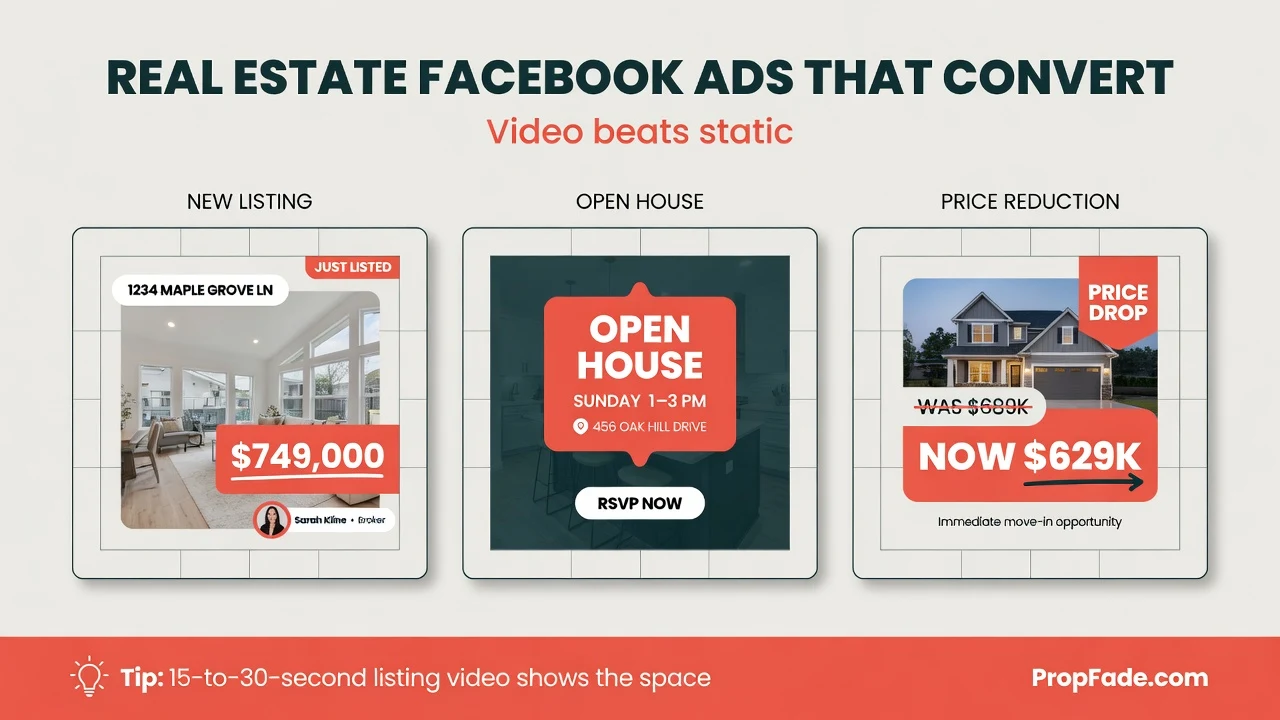
Single-image ads are the simplest to produce and work well for open house dates, price reductions, and just-listed announcements. One sharp exterior photo with the address, price, and open house time makes an effective short-run awareness push.
The Housing Special Ad Category
Facebook requires all real estate ads to run under the Housing Special Ad Category, which restricts certain demographic targeting to comply with fair housing regulations. Select this category when creating the campaign. Geographic, behavioral, life event, and custom audience targeting still function within the category.
Targeting real estate Facebook ads to find buyers and sellers
Facebook targets real estate ads by zip code, the “likely to move” life event signal, and custom audiences built from your past client list or website visitors. All housing ads require the Housing Special Ad Category, which limits some demographic exclusions.
This reference maps each audience type to its setup and best use case.
| Audience type | What it targets | Best for |
|---|---|---|
| Geographic | City, zip code, or radius from a pin | Any listing campaign |
| Life event: likely to move | People whose activity signals an upcoming move | Seller lead campaigns |
| Custom audience (client list) | Past clients or contacts uploaded from your CRM | Warm retargeting |
| Website custom audience | Pixel visitors who viewed listings or a valuation page | High-intent retargeting |
| Lookalike audience | New people who match the profile of your past clients | Scaling to new markets |
| Interest targeting | Home buying, real estate, mortgages, home improvement | Cold prospecting |
Geographic and behavioral targeting
Set a geographic radius around your farm area, a single zip code, or a cluster of neighborhoods. Facebook allows targeting as tight as a one-mile radius from a specific address, which is useful for hyper-local listing campaigns. For seller lead campaigns, target the zip codes where you have closed in the last 12 months and know the inventory well.
Layer behavioral signals on top of geography. The “likely to move” life event reaches people whose browsing and activity patterns match someone preparing to change homes. Pair it with homeownership interest for seller-focused campaigns or with home-buying and mortgage interests for buyer lead campaigns.
Custom and lookalike audiences
Upload your past client list (name, email, and phone) as a Custom Audience to retarget people who already know you. Facebook matches the list against its user base and shows your ad specifically to those contacts.
Build a Lookalike Audience from that same list to find new prospects who share the same demographic and behavioral profile as your past clients. A source list of at least 500 people produces a reliable lookalike; larger lists give Facebook more signal and tighter matches.
Install the Facebook Pixel on your website so that every visitor who views a listing or requests a home valuation joins a retargeting audience automatically. Website visitor audiences produce stronger lead rates than cold audiences because they have already engaged with your listings.
Real estate Facebook ad creative that converts: video beats static
A 15-to-30-second listing video shows the space, holds attention in the feed, and gives buyers a walkthrough feel before they visit the home. Carousel ads with four to six rooms are the strongest static option when video is unavailable.
What a high-performing real estate video ad includes
Open the video with the home’s most compelling feature, because the first two seconds decide whether someone keeps watching. The kitchen, a view, or a recently renovated bathroom makes a strong hook. Keep the total length between 15 and 30 seconds for feed placements and up to 60 seconds for retargeting audiences who already know the listing.
Add text overlays for the price, address, and bedroom and bathroom count. Many Facebook users watch video with the sound off, so burning these details directly into the video makes the ad communicate without audio. End with a clear call to action: “See photos” or “Request a tour” both work.
A consistent brand frame, a logo or headshot in a corner, and a matching color palette across your ads builds recognition over time. Buyers who see your name across several ads before reaching out already carry a baseline of familiarity.
Creating listing videos for Facebook ads
PropFade turns a set of listing photos into a formatted video ad in about two minutes. Upload 12 to 20 photos, add the listing details, and the platform animates each frame, adds a voiceover from the listing details, and exports three formats at once: a 9:16 vertical cut for Reels and Stories, a 1:1 square cut for the main feed, and a 16:9 landscape cut for YouTube or a listing page. One project covers every Facebook placement.
For a broader look at video production options, the ai real estate video editor guide covers tools for filming, editing, and formatting real estate listing videos.
Make a Facebook ad video
Upload your photos and get a finished video back in about two minutes.
Headline and copy best practices
Write the ad headline around the listing’s strongest feature, not the street address. “4-bed with rooftop deck, asking $485k” tells the buyer why to click before they read the address, and outperforms a bare street name in the headline slot.
Keep primary text to two or three sentences: the hook, the core details, and the next step. Lead with the standout feature, add the price and neighborhood, and close with the action. The feed preview shows roughly 125 characters of primary text before a “See more” truncation, so write for that preview.
Budget and tracking for real estate Facebook ad campaigns
Start with 10 to 20 dollars per day per ad set for the first two weeks to give Facebook’s algorithm enough data to optimize delivery. Track cost per lead rather than click-through rate, because a high-click ad that produces no lead form submissions is spending without results.
Setting a starting budget and campaign structure
Facebook’s delivery algorithm needs roughly 50 lead events per ad set to exit the learning phase and stabilize performance. At 10 to 20 dollars per day, most campaigns reach that threshold within two weeks when the target audience is large enough. Cold geographic audiences should be at least 500,000 people; custom and retargeting audiences can be much smaller.
Run two or three ad sets at the same time to compare creative and audience combinations. Give each ad set its own daily budget rather than using campaign budget optimization at the start, so one ad set cannot outspend another before you understand which is producing better leads.
Key metrics for real estate Facebook ads
Cost per lead is the headline metric for Lead Generation campaigns. Compare cost per lead across ad sets to find which audience and creative combination produces the lowest number, then shift budget toward the winner.
Click-through rate (CTR) shows how well the creative performs with the audience. A CTR below 0.5 percent on a cold audience usually signals that the creative or headline needs a revision. A CTR above one percent on a cold listing audience is a positive signal to increase the daily budget gradually.
Frequency tracks how many times each person has seen the same ad. When frequency climbs above three on a cold audience, the ad is wearing out with that group. Rotate the creative or expand the audience when frequency rises.
Connecting leads to your CRM and tracking revenue
Facebook’s native Lead Ads integration sends form submissions directly to most real estate CRMs. New leads receive an automated follow-up text or email within minutes of submitting, so the contact happens while the prospect still remembers the listing.
Add UTM parameters to any Traffic campaign links so Google Analytics ties ad spend to specific site actions, such as a home valuation request or a showing booking. Over time, UTM data in your CRM connects Facebook spend to closed revenue and gives you a real cost-per-transaction number.
For a comparison of paid channels, the google ads for real estate guide covers search-intent targeting, and real estate marketing ideas maps the full channel mix. For distributing listing videos across organic social alongside paid, see real estate social media.
Frequently asked questions
You create a campaign, choose a targeting audience (geographic area, life events like likely to move, or a custom list from your CRM), and run ad creative to that audience. Lead Generation campaigns show a contact form inside Facebook when someone clicks, capturing their name and contact info without them leaving the app. Traffic campaigns send clicks to your website, listing page, or home valuation tool.
A starting daily budget of 10 to 20 dollars per ad set gives Facebook's algorithm enough data to optimize within about two weeks. Total monthly spend depends on your market and goals, but many agents start with 300 to 600 dollars per month across two or three ad sets and scale after identifying which audience and creative combination produces the lowest cost per lead.
A strong real estate Facebook ad opens with the property's best feature, states the price and location clearly, includes text overlays for viewers watching with sound off, and closes with a specific call to action. Video outperforms static images for listing ads because it shows the space in motion. Consistent branding across ads builds recognition with buyers and sellers in your market over multiple impressions.