
A listing presentation is the meeting where a homeowner decides whether to hire you. Most run 45 to 60 minutes and follow a six-section structure: a brief intro, a market snapshot, a pricing recommendation, your marketing plan, Q&A, and a close.
This guide walks through every phase, hands you a copy-paste checklist and three scripts for the pricing conversation, and shows you a follow-up sequence for sellers who need a day to decide. Preparing the system for the first time takes about an hour; each appointment after that runs under 30 minutes of prep.
Before the appointment: research, prep, and your pre-listing package
Arrive with a current CMA, the sellers’ timeline, and a leave-behind that demonstrates your process. Agents who bring neighborhood data own the room; the sellers’ own online research fills that gap when an agent arrives without it.
Pull comps the day before, not the morning of. Look for three to five closed sales within half a mile, the same bed and bath count, and a square footage within 10 to 15 percent of the subject property as a starting filter. In rural, luxury, or low-inventory markets where that search returns fewer than three usable comps, widen the radius to one or two miles, extend the look-back to 180 days, or include adjacent towns and note any adjustments for lot size, view, or condition. Record the price per square foot, the average days on market for the neighborhood, and any active listings the sellers’ home will compete with directly.
Learn why they are moving and when before you arrive. A seller with 90 days of flexibility weighs top dollar differently than a seller with a hard 30-day deadline, who will trade price for certainty. Ask the timeline question on your pre-listing call or intake form so you can frame the pricing section accordingly.
Send a short pre-listing package the evening before. One page covering your background, two or three real estate listing presentation examples from past clients in the same price range, and a note on what you plan to cover. Sellers who receive it arrive comparing you to agents who sent nothing.
Prepare or update your real estate listing presentation template with the current neighborhood data and the subject property address. A template with live numbers reads as current; a generic one reads as a printout from another appointment.
The listing presentation flow, section by section
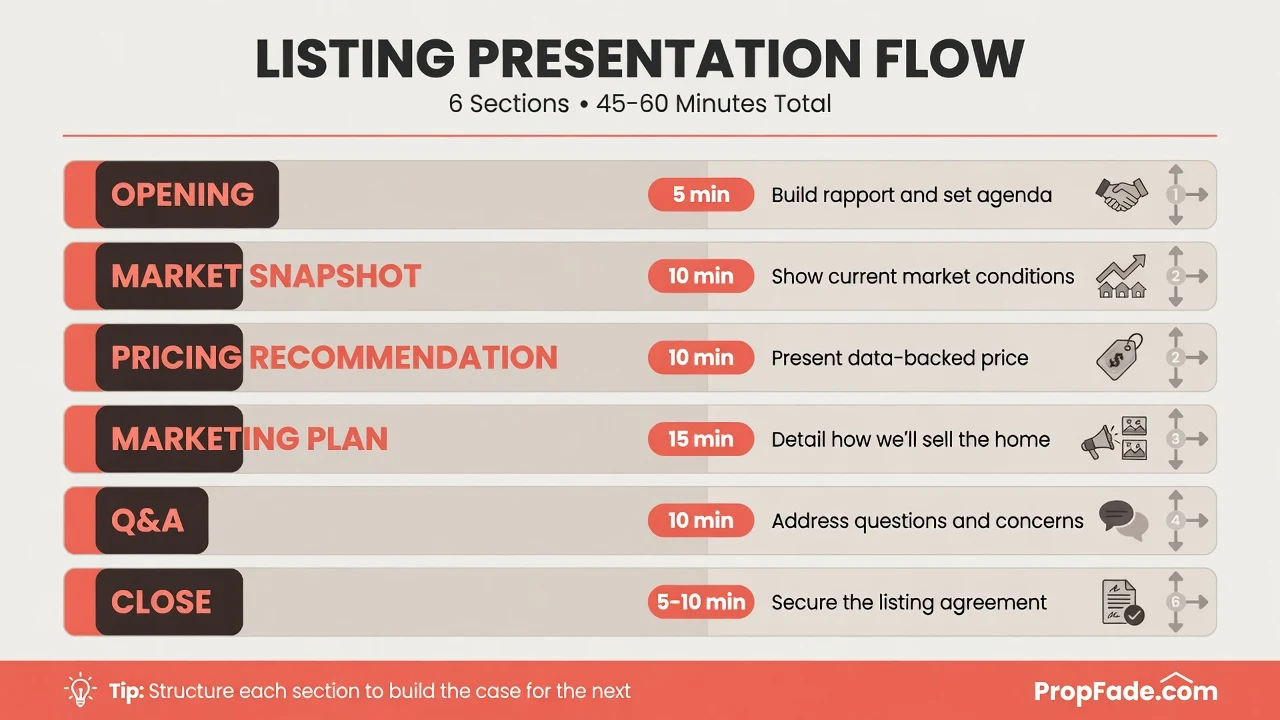
A strong listing presentation runs six sections in roughly 45 to 60 minutes: a brief intro, a market snapshot, a pricing recommendation, your marketing plan, Q&A, and a close. Each section builds the case for the next.
Section 1: Opening (5 minutes). Name the agenda at the start. “I have six things to cover and I’ll leave room for every question” sets expectations and signals that you prepared. Spend two minutes on your background, focused on results in this neighborhood or price range, then move into the data.
Section 2: Market snapshot (10 minutes). Present the neighborhood data before you name a price. Walk through the last 90 days: how many homes sold, what the median days on market was, and what percentage of list price sellers received on average, a metric the National Association of Realtors tracks annually. Numbers anchor the conversation before the price discussion begins.
Section 3: Pricing recommendation (10 minutes). Present your CMA and state the range. Name the lower end as the fastest-move price and the upper end as the price that needs patience. Walk through which comps support each end. When the data does the convincing, you do not need to defend a number.
Section 4: Marketing plan (15 minutes). Walk through every specific tactic with a concrete timeline. Professional photos on day one. MLS syndication with a search-optimized description on day two, produced with the real estate listing descriptions guide and the writing real estate descriptions guide for room-by-room formulas. A listing video in three formats from the same photos in the same week. Open house in week two.
This is the section where the listing video becomes a named deliverable, not a vague promise. Once you have the listing photos, a slideshow video editor produces a 9:16 Instagram Reels-ready cut, a 1:1 social feed cut, and a 16:9 web cut from the same photo set in an afternoon. Show a sample in the meeting and reference the real estate listing presentation template you use to walk sellers through the marketing calendar.
Section 5: Q&A (10 minutes). Invite every question and answer with data when you have it. Write down any question you cannot answer on the spot and commit to a specific follow-up within 24 hours.
Section 6: Close (5 minutes). Present the listing agreement and walk through three points: the recommended list price and the CMA behind it, the commission and exactly what it covers, and the listing term.
Handle pricing objections: three scripts that hold the number
Most pricing objections follow one of three patterns: the sellers’ online estimate is higher, a neighbor’s home sold for more, or the renovation cost more than the market returns. A short, data-backed response handles each.
These scripts work because they validate the concern, anchor to comps, and redirect to outcome. Memorize the structure rather than the exact words so each response lands naturally in a live conversation.
Script 1: “The online estimate shows $X.”
“I ran the same sold addresses the algorithm uses. The difference usually comes down to condition and timing. My CMA accounts for the specific comps, the current days-on-market trend, and the active listings buyers will compare yours against. The number I’m recommending is the number that brings a qualified offer within [your target timeline], not the number that requires a price reduction in week three.”
Script 2: “My neighbor sold for $X on a similar home.”
“That sale is [one of my comps / outside my comp set because of X]. At your home’s square footage, the price per square foot at my recommended number is $Y, which is [above / in line with] that neighbor’s result. The gap from your expectation is $Z. Let me show you what homes that listed at the higher price did in this market over the last 90 days.”
Script 3: “We put $X into the kitchen renovation.”
“Renovations raise both value and buyer expectations about condition. The appraisal will use the same comps I am using, per Fannie Mae’s comparable-sales guidelines. When a home is priced above appraised value, the gap falls to the buyer’s financing, and deals often fall apart there. The range I am recommending already reflects the updated kitchen as a condition advantage over the comparable sales.”
Pricing objection scripts
The online estimate shows $X.
I ran the same sold addresses the algorithm uses. The difference usually comes down to condition and timing. My CMA accounts for the specific comps, the current days-on-market trend, and the active listings buyers will compare yours against. The number I'm recommending is the number that brings a qualified offer within [your target timeline], not the number that requires a price reduction in week three.

My neighbor sold for $X on a similar home.
That sale is [one of my comps / outside my comp set because of X]. At your home's square footage, the price per square foot at my recommended number is $Y, which is [above / in line with] that neighbor's result. The gap from your expectation is $Z. Let me show you what homes that listed at the higher price did in this market over the last 90 days.

We put $X into the kitchen renovation.
Renovations raise both value and buyer expectations about condition. The appraisal will use the same comps I am using. When a home is priced above appraised value, the gap falls to the buyer's financing, and deals often fall apart there. The range I am recommending already reflects the updated kitchen as a condition advantage over the comparable sales.
Quick-start checklist: the ten things to do before you arrive
Run this checklist the day before every listing appointment. Each item takes five to ten minutes; the full list takes under an hour and covers the gaps that lose listing presentations most often.
- Pull the CMA: three to five closed comps, two to three active competitors, price per square foot, and average days on market
- Research property history: prior sale price and any previous listing with price reductions
- Confirm the sellers’ timeline and motivation from your pre-listing call or intake form
- Update your real estate listing presentation template with current neighborhood data and the subject property address
- Select two or three real estate listing presentation examples from past clients to use as leave-behinds
- Write the marketing plan with specific tactics and dates: photos, description, listing video, MLS, and open house
- Prepare a sample listing video or a real estate flyer mock-up to show the marketing plan in action
- Confirm the appointment time, address, and who else from the household will attend
- Pack a printed CMA, the listing agreement, and a digital backup of all materials
- Send the pre-listing package the evening before
Common mistakes to avoid in a listing presentation
The four mistakes that lose listings most often: arriving without a current CMA, leading with the price before building value, presenting a vague marketing plan, and leaving without asking for the listing agreement.
Arriving without a CMA. When agents show up without data, they either accept the sellers’ online estimate or push back without evidence. Prepare the CMA the day before, bring a printed copy, and load it on a device where you can scroll through the comps together.
Opening with the price. Naming a number before establishing your value and your process gives sellers a figure to react to before they understand the reasoning. Run the market snapshot first. The pricing recommendation lands more easily once the neighborhood data is in front of both of you.
A vague marketing plan. “We’ll put it on the MLS and market it heavily” names an intent, not an action. Walk through every tactic with a specific date: photos on day one, a search-optimized description from the real estate listing descriptions guide on day two, a listing video in three formats from the photos in the same week. Agents who show a calendar beat agents who describe enthusiasm.
Skipping the close. Agents who present well and then wait for the sellers to ask for the paperwork lose to agents who ask directly. After Q&A, say: “I would like to get this listed in time for the weekend traffic. Do you want to go through the agreement now?” A direct ask closes more appointments than waiting for a signal.
Close the appointment and follow up within 24 hours
Ask for the signature at the appointment. A follow-up call the next morning closes more of the listings that were close but needed a day, compared to any other single action in the sequence.
At the close section, walk through three things in the listing agreement: the recommended list price and the CMA that supports it, the commission structure and exactly what it covers, and the listing term. Pause after each item and invite questions. Most objections surface here and resolve quickly when you have already walked through the data.
If they ask for more time, set a specific next step before you leave the appointment. “I will call you tomorrow at 10. I will have [the additional comp / the marketing video sample / the answers to your questions] ready.” Open timelines (“I’ll be in touch”) create space for competing agents.
The 24-hour follow-up script: “Hi [name], it is [agent]. I have the [answers / extra comp / listing video sample] I mentioned yesterday. I also put together a draft of what the marketing looks like from day one, including the listing video and the real estate flyer for the open house. Can we get the agreement signed this week?”
For sellers who choose another agent, ask one question before the call ends: “Can I ask what made the difference?” The answer is the most useful feedback you can collect. It shows you which section of your presentation is losing the decision and turns each lost listing into a sharper approach for the next appointment.
Frequently asked questions
Prepare a current CMA and a specific marketing plan the day before the appointment. Run six sections in 45 to 60 minutes: a brief intro, a market snapshot, your pricing recommendation, your marketing plan, Q&A, and a close. Ask for the listing agreement at the appointment rather than waiting for the sellers to bring it up.
Open by naming the agenda and summarizing your results in the neighborhood. Walk through the market data, then your CMA with a price range and the comps behind it. Present the marketing plan with specific tactics and dates. Invite questions, then close by walking through the listing agreement. Keep each section focused on one goal.
Arrive with a current CMA, a printed marketing plan with named tactics and dates, and two or three examples from past clients in the same price range. Present the market snapshot first so the pricing recommendation lands with neighborhood data as context, then walk through the marketing plan. Ask for the agreement at every appointment and follow up by phone within 24 hours if the sellers need time to decide.