
Real estate direct mail reaches homeowners before they open a search site. A postcard lands in the mailbox, sits on a counter for days, and keeps your name visible through the months-long process of deciding to sell.
This guide covers the four parts of a working direct-mail program: when direct mail outperforms digital, building a targeted list, designing mailers that generate calls, and tracking return on every dollar spent. For the full channel mix, start at the real estate marketing ideas hub, then layer direct mail in.
Does real estate direct mail still work?
Yes. Direct mail reaches homeowners before they start searching online. Physical mail commands disproportionate attention in most markets because agents abandoned print for digital, leaving mailboxes uncrowded. Consistent monthly mailings build name recognition over 6 to 12 months.
The channel performs best for geographic farming. An agent who mails the same 400 homes every five weeks for a year becomes the familiar name in that neighborhood when any resident decides to sell. That familiarity shortens the time from first contact to listing appointment.
Direct mail also delivers for one-time campaigns. Just-listed and just-sold announcements reach neighbors who may know buyers in the area. Home-valuation offers pull in homeowners curious about their equity. Expired-listing letters reach sellers whose contract recently lapsed and who are ready to try a new approach.
Unique real estate marketing ideas that pair print with video outperform print alone. A QR code on a mailer that opens a listing real estate video lets the recipient watch a full property tour from a piece of paper. Print triggers the action, and video answers the question.
The agents winning with direct mail in 2026 pair a consistent mailing schedule with tracked digital destinations. A retargeting ad follows anyone who scans the code over the next 30 days, turning a single print touch into a multi-channel sequence.
Build your real estate mailing list: farm areas, absentee owners, and expireds
A real estate mailing list starts with 200 to 500 addresses in a defined area with at least 5 percent annual turnover. Add absentee owners, expired listings, or equity-rich homeowners from county records.
Select a neighborhood, ZIP code section, or carrier route where you want to become the recognized agent over time. Look for areas with 5 to 8 percent annual turnover, meaning 10 to 40 homes sell per year in a 200-home farm. Higher turnover means more listing opportunities per dollar of mail spend.
The USPS Every Door Direct Mail program (EDDM) saturates every address on a carrier route without a purchased address list. You select target routes and pay postage through the USPS EDDM online tool, but USPS does not print or produce your mailers. You must print compliant mailpieces with the required EDDM retail indicia, bundle them in stacks with facing slips, and drop them at a local post office or Business Mail Entry Unit (BMEU) for induction. Many agents work with a print vendor from the USPS Printer Directory to handle production and drop-off. EDDM is cost-effective for broad geographic reach because it removes the list purchase cost and lowers per-piece postage compared to standard marketing mail. Check current EDDM rates at usps.com before budgeting.
Address lists from purchased sources degrade at 10 to 15 percent per year as residents relocate. Specify NCOA (National Change of Address) processing when ordering any purchased list. Removing bad addresses before printing prevents waste on undeliverable pieces and keeps your cost-per-contact accurate for ROI calculations.
Absentee owners hold property where the mailing address differs from the property address, including landlords and second-home owners who may consider selling at the right price. County assessor records identify these properties by comparing the registered owner address against the property address.
Expired listings are homes that came off the market unsold, and those sellers still want to move. A well-crafted letter from a new agent often gets opened. Your MLS and county transfer records supply the addresses.
Equity-rich homeowners have owned long enough to have significant equity at current market values. A home-valuation offer gives them a reason to call, and county records and list services both provide filters for estimated equity position or length of ownership.
Start with one list segment and establish the cadence before adding a second. Dividing budget across three untested segments at launch makes it harder to identify which message is working.
Design a real estate mailer that gets calls: copy, layout, and size
Put one clear offer above the fold, name a local market fact, and add your headshot, phone number, and a QR code. Standard high-response sizes are the 4x6 postcard and the 6x9 postcard.
Open with a local fact that demonstrates market knowledge. “14 homes sold in [Neighborhood] this quarter” or “Your neighbor closed for $X over asking” anchors the mailer in verifiable reality and earns a second read. Agents who lead with a generic headline lose the stack.
State the offer in one sentence. “Find out what your home is worth this month” or “See what just closed on your block” is specific and actionable. Vague labels like “spring market update” give the recipient no reason to respond.
Add your headshot, name, brokerage, phone number, and a QR code linking to a useful digital destination: a home-valuation landing page, a neighborhood market report, or a listing video tour for a just-sold announcement. A video or valuation page gives the recipient a concrete reason to point their camera at the code.
Close with a single next step. “Scan to watch the full tour” or “Call for a complimentary home valuation” is one action the recipient can take immediately.
The 4x6 postcard fits a standard mailbox slot and qualifies for the lowest USPS postcard postage rate. The 6x9 postcard stands out in a mail stack and gives room for a data table or testimonial on the back. Both are standard formats at commercial real estate printers, and short-run digital printing keeps costs manageable for 400 to 500 piece campaigns.
Standard print file specifications for a 4x6 or 6x9 postcard include 300 DPI image resolution, a 0.125-inch bleed on all four sides, and a 0.125-inch safe zone for text and logos. Most commercial print vendors deliver short runs of 400 to 500 pieces in 5 to 7 business days. Build two additional weeks into your mailing calendar for file proofing and postal acceptance review.
Gloss coating on the front increases perceived quality and protects a photo-heavy image. Matte coating on the back allows handwriting, useful for personalized notes to specific streets.
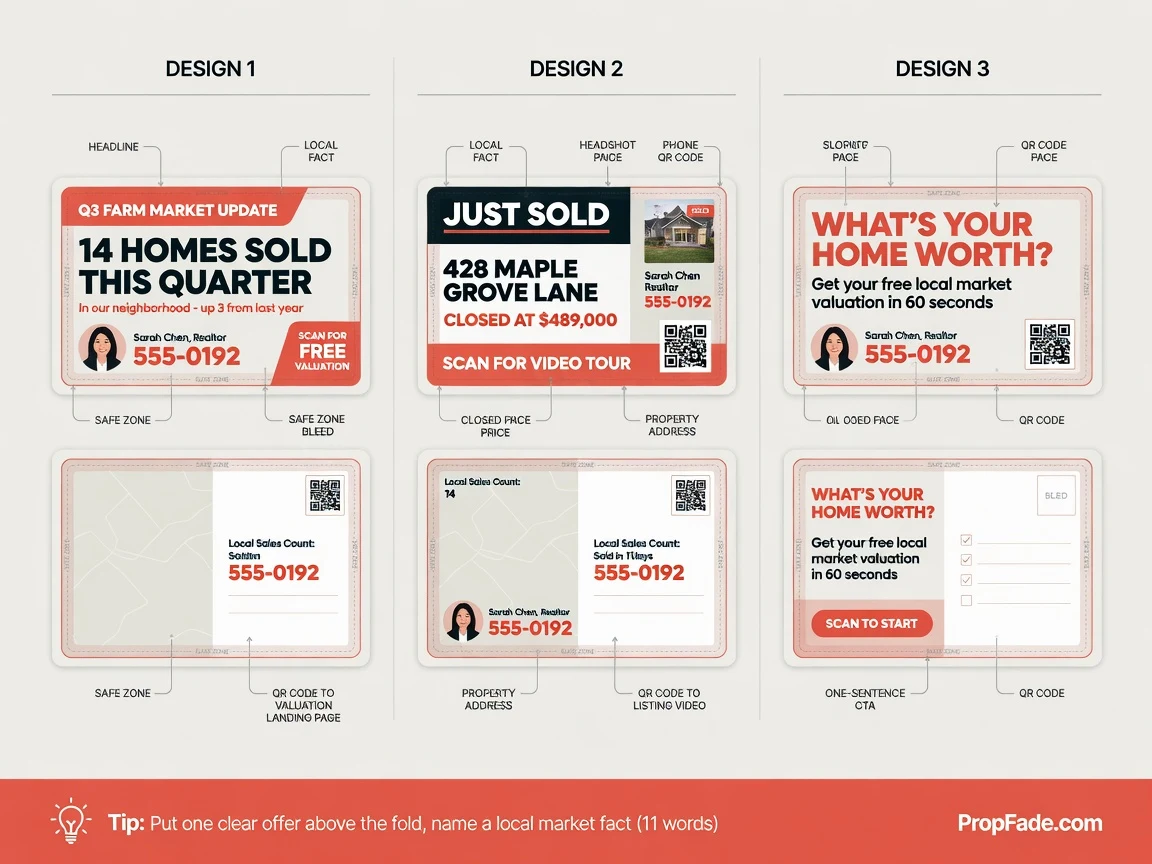
For format comparisons and additional layout options, the real estate postcards guide covers size categories and USPS rate classes in detail.
Copy-paste mailer checklist:
- Local market fact or hook sentence (front, prominent type)
- One-sentence offer (front, largest text)
- Agent headshot, name, and brokerage (front, lower third)
- Phone number and QR code (front)
- Market data table or client testimonial (back)
- Repeated call to action (back)
- Brokerage license disclosure (back, small print)
What to link your direct-mail QR code to
A QR code on a postcard creates an expectation. A static page or bare MLS link rarely satisfies it. The destination should answer the question the mailer raised within the first five seconds on a phone screen.
Three pairings that produce a trackable lift:
Just-sold postcard to listing tour. Link the QR code on the back of the postcard to a video walkthrough or photo tour of the home that just sold on their street. Neighbors who scan want to see inside and learn the price context. Host the tour on a dedicated landing page rather than a social media post so every scan is captured in your analytics.
Seller valuation mailer to market report. Build a neighborhood market page or short video summarizing the last quarter of sales activity: closed prices, days on market, and price-per-square-foot trend. The QR code drives to that context before the valuation form. Recipients arrive at the form with the market picture already framed, which raises form completion.
Expired outreach letter to proof of preparation. A one-page market analysis or a short video demonstrating knowledge of their specific property and street is evidence of preparation before any listing call. A QR code in the letter links to it as the first step, separating you from the form letters every expired seller receives.
Use a consistent UTM structure so your analytics separate direct-mail QR scans from other traffic:
utm_source=directmailutm_medium=postcardorutm_medium=letterutm_campaign=farm_[neighborhood]_[YYYYMM]orutm_campaign=justsold_[address]utm_content=qr_videoorutm_content=qr_valuation
Add video scan count and watch-completion rate to your ROI spreadsheet alongside inbound calls and leads. A campaign that generates 40 QR scans with 30 video completions in a 400-home farm is producing measurable engagement before a single phone call arrives.
Direct-mail cadence and ROI tracking for real estate agents
Mail once every 4 to 6 weeks for a minimum of 12 consecutive months. Track ROI by assigning each send a unique phone number or QR code URL, then compare total mail spend against gross commission at year end.
Name recognition in a geographic farm builds through repetition, a principle the National Association of Realtors covers in their direct-mail guidance for agents. Farm contacts typically begin recognizing an agent’s name without prompting around the 6th to 9th mailing, corresponding to 6 to 9 months of consistent sends. Stopping at month 4 forfeits the investment made in months 1 through 3.
A 12-month calendar for a 400-home farm: market update (January), just-sold announcement (February), spring buyer demand report (March), spring activity spotlight (April), summer sales summary (June), mid-year price review (August), fall market outlook (September), year-in-review piece (December). Vary the offer so each mailer delivers something worth reading. Keep the template consistent so recipients recognize the piece before they read the copy.
Pair your mailing calendar with your broader real estate marketing strategies plan so print, social, and email reinforce the same message in the same weeks. A mailing paired with a social post targeting the same neighborhood doubles exposure for the same creative.
Assign each mailing a trackable element: a dedicated call-tracking phone number, a QR code URL with UTM parameters, or a campaign-specific landing page. When a lead calls or scans, your CRM records the source. Without tracking, you cannot attribute a commission to the channel.
Log these fields for every send: send date, mailer type, list segment, quantity mailed, print cost, postage cost, total cost, inbound calls, leads generated, listing appointments booked, closed deals, and gross commission. The ROI formula is total commission divided by total spend over the full tracking period.
A concrete example: a 400-home farm mailed 10 times in a year at an all-in cost of $0.75 per piece (print plus postage) totals $3,000 for the year. One listing closed at a median gross commission of $9,000 returns three times the annual spend. Two closings from that farm within 12 months make the channel self-funding through the next full calendar year.
Review real estate digital marketing ideas for how to add retargeting pixels to your QR landing pages so anyone who scans sees follow-up ads over the next 30 days.
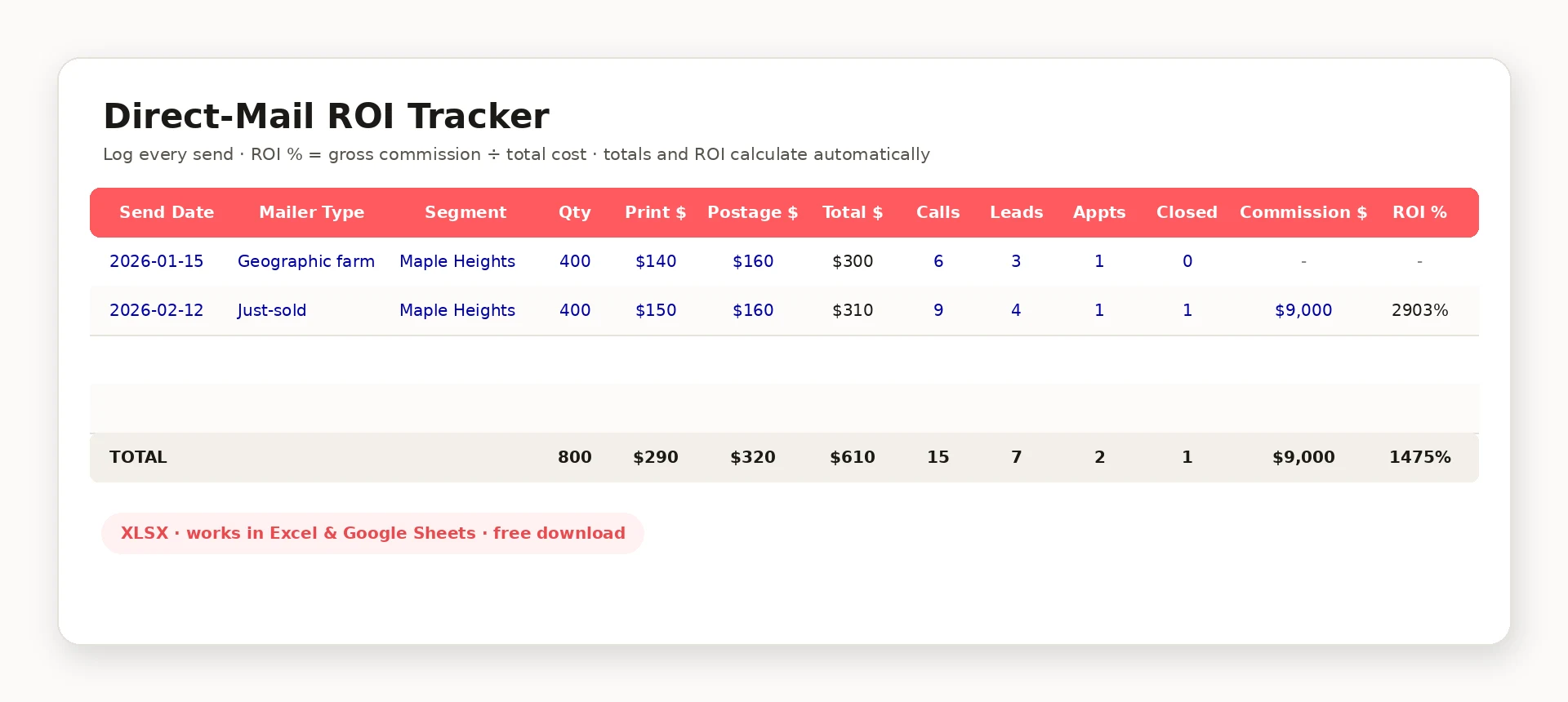
The Direct-Mail ROI Tracker (Excel)
Send log with print, postage, lead, and commission columns, two example rows, a totals row, and the ROI formula pre-built. Opens in Excel or imports into Google Sheets.
At the 12-month mark, cut any list segment that produced no inbound contact and redirect that budget to segments performing above zero. A farm that closes one listing per year in a mid-range market typically returns several times its annual mail spend in gross commission. To track direct mail alongside every other channel in one workbook, the real estate marketing management template extends the same logging approach across your full budget.
Frequently asked questions
Yes. Direct mail reaches homeowners before they begin searching online, and physical mail draws more attention than crowded digital inboxes in most markets. Geographic farming with consistent monthly mailings builds recognizable name presence over 6 to 12 months, and that familiarity shortens the time from first contact to listing appointment.
Printing and postage for a 4x6 or 6x9 postcard run of 400 to 500 pieces typically starts around $200 to $400 all in, depending on size, coating, and mail class. USPS Every Door Direct Mail (EDDM) can reduce per-piece postage for saturation campaigns. Check current EDDM rates at usps.com and request quotes from two or three print vendors before committing to a volume.
Lead with a local market fact (a recent sale price or the number of homes sold in the neighborhood), state one clear offer in a single sentence (a home valuation, a just-sold announcement, or a market report), add your headshot and contact details, and close with a QR code linking to a useful digital resource. Keep the front to one image, one offer, and one call to action.