
Real estate yard signs work from listing day to closing, turning every driver, neighbor, and passerby into a potential call. The National Association of Realtors’ annual Profile of Home Buyers and Sellers tracks yard signs among the information sources through which buyers first learn about homes they consider purchasing. The right combination of sign type, design, and material keeps the phone ringing without any additional effort from the agent.
This guide covers the four main sign types, design principles that get calls from the street, current vendor costs, and which sign fits each listing scenario.
Types of real estate yard signs: yard panels, riders, directionals, and posts
The four core types are the main yard panel, rider signs, directional arrows, and post-and-panel systems. Each plays a distinct role in a listing’s street presence.
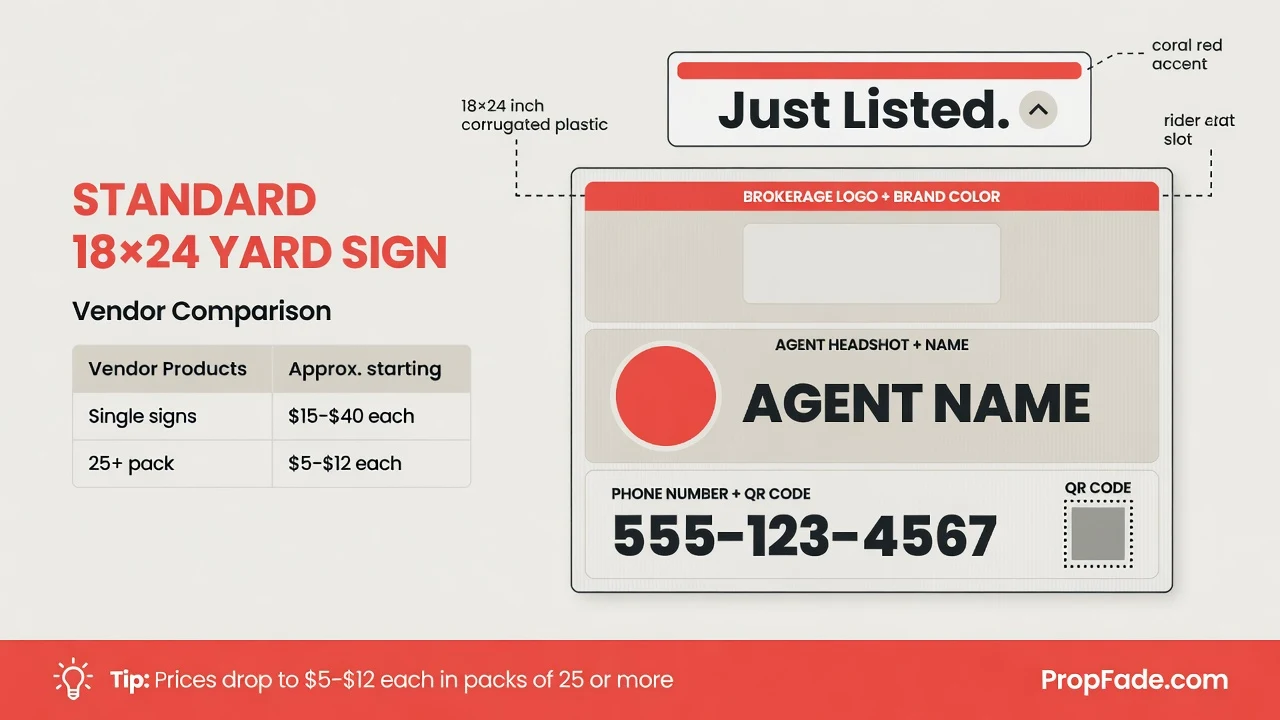
Yard panels are the standard listing sign: a flat panel staked into the front lawn or attached to a post. The most common size is 18 by 24 inches. Corrugated plastic (also called coroplast) is the standard material for short-term listings because it is lightweight, weatherproof, and inexpensive. Aluminum and rigid PVC panels last longer, hold color better under direct sun, and look sharper for upscale listings.
Riders are smaller panels, typically 6 by 24 inches, that clip above or below the main sign. Common messages include “Just Listed,” “Open House,” “Price Reduced,” “For Rent,” and “Sold.” A set of five or six riders covers every stage of the listing without replacing the whole panel. Riders from most vendors cost around $5 to $15 each.
Directional signs are arrow-shaped panels placed at nearby intersections to guide buyers navigating by car. A single listing often needs three to five directionals, depending on the property’s distance from a main road. Corrugated arrow signs run around $5 to $15 each in bulk, and most agents keep a standing inventory of 10 to 15 directionals to swap between active listings.
Post-and-panel systems replace the wire H-frame stake with a heavier aluminum or wood post. The result is more polished and holds up better in firm soil or on sloped lawns. Post hardware is a one-time purchase, typically $30 to $150 depending on post gauge and style, and the panels swap out per listing. They are standard in luxury markets where the post itself signals brand quality.
Sign design that gets calls: layout, QR codes, and branding
Before finalizing any design, check your brokerage brand standards, state real estate licensing rules, and local sign ordinances. HOA agreements and municipal codes in many markets restrict sign dimensions, placement distance from the curb, and the relative prominence of agent versus brokerage branding. Open-house directional signs often fall under separate local rules governing placement and retrieval timing, a landscape NAR has examined through its analysis of real estate sign law. The layout principles below reflect common street-readability practice and apply within those constraints.
A readable real estate sign puts the agent’s phone number in the largest type the brokerage brand standards allow, ideally at least 2 inches tall, so drivers can read it from a moving car. Everything else on the panel supports that number.
Visual hierarchy: Organize the panel into three zones. The top third carries the brokerage logo and brand colors. The middle third holds the agent name and, if the brokerage allows it, a headshot. The bottom third is the phone number in the largest type on the sign. A QR code fits in the lower corner without competing with the number. Keep the total number of elements to five or fewer: logo, agent name, phone, and one secondary contact element.
QR codes: A QR code turns a passive sign into an active link. Buyers scan from the curb and land on the listing page with photos, price, and contact details. For maximum engagement, lead that page with a short animated listing video above the static gallery. A buyer who watches a 30-second walkthrough at the curb is further into the decision than one who scrolls a photo grid. Size the code at 2 by 2 inches minimum so it scans reliably from a few feet away, consistent with the dimensional specifications in ISO/IEC 18004, the international QR Code symbology standard. Link it to a page that loads fast on a mobile connection. Test the link on both iOS and Android before the sign order ships, and confirm the destination still loads correctly after any price update.
Consistent branding: The sign should share the same headshot, font, and brand colors used in the agent’s real estate flyer and digital content. Buyers who see the same face on the yard sign and in a Facebook ad recognize the agent faster. Keeping visual identity consistent across every touchpoint builds name recognition across an entire farm area.
Color contrast: White backgrounds with dark text (navy, forest green, or dark red) read clearly in daylight and under streetlights. High-contrast yellow and red accents draw the eye but look budget when overused. Luxury listings typically use one or two neutral brand colors with a single accent, matching the approach used in a real estate flyer template and other print pieces.
Real estate sign costs and where to buy: a vendor comparison
Standard 18-by-24-inch corrugated plastic yard signs cost starting around $15 to $40 each at single quantities. Prices drop to roughly $5 to $12 each when ordered in packs of 25 or more.
| Vendor | Products | Approx. starting price | Notable for |
|---|---|---|---|
| BuildASign (buildasign.com) | Corrugated, aluminum, riders, posts | ~$18 per panel (single) | Full browser design tool, fast turnaround |
| Signs.com | Corrugated, aluminum, banners | ~$22 per panel (single) | No-minimum orders, live proof preview |
| Oakley Signs (oakleysigns.com) | Agent-specific panels, riders, post systems | ~$12 per panel (bulk tier) | Agent-focused templates, volume discount tiers |
| Amazon | H-frame wire stakes, budget corrugated panels | ~$10 to $25 per panel | Fast shipping for hardware and replacement riders |
Prices are approximate starting points as of mid-2026. Check current pricing directly with each vendor; brokerage and volume discounts vary significantly.
Hardware and stakes: The H-frame wire stake is the standard ground anchor, available for around $5 to $10 each. A step stake with a foot plate installs faster, useful for agents setting and collecting many signs each week. Post-and-panel hardware ranges from around $30 for a single aluminum post to $150 for a heavy-duty double post with decorative cap.
Annual budget by volume: An agent closing 15 to 25 listings per year using corrugated signs at roughly $20 each spends around $300 to $500 on panels annually, plus one-time hardware costs. Moving to aluminum panels at $60 to $80 each costs more per unit but requires far fewer replacements. High-volume agents often negotiate direct pricing with a local print shop or a vendor like Oakley Signs.
Buying strategy by scenario: Local print shops are worth considering when turnaround is critical and the design is final; they often match online pricing on small runs without the shipping lead time. For any new design, order a single proof before committing to a full run. Review the proof against the design file at close range and again from 30 feet to confirm phone number legibility and color accuracy. Plan for one replacement per listing in wet or high-UV climates when using corrugated panels. Aluminum and rigid PVC panels typically last five to ten listing cycles, so the higher per-unit cost recovers quickly for agents closing more than 15 listings per year. Tracking total sign spend per listing (panel, riders, stakes, and directionals combined) against the listing commission creates a documented marketing cost-per-listing figure that supports a value conversation with future sellers.
Matching the right sign to your listing type and market
The best sign setup depends on listing volume, the market segment, and how much weather and time the sign will face. Four agent profiles cover most scenarios.
High-volume residential agent (15 to 30 listings per year): Corrugated plastic panels ordered in bulk deliver the lowest per-sign cost. A single consistent template with a headshot and clear branding makes every yard recognizable across the farm area. Add a set of six riders (Just Listed, Open House, Price Reduced, Under Contract, Sold, and For Rent) to cover each listing stage without a redesign. The same template works for print pieces when you create a real estate flyer for each new listing.
Luxury or premium listing: An aluminum panel with a post-and-panel system signals quality that matches the property. Pair it with a custom-designed panel using professional photography and a matte finish, which photographs better for social content. The per-sign investment is higher, but the listing price justifies it and the panel carries through multiple luxury listing cycles.
Open house specialist: Directional signs are the priority. A set of 5 to 10 corrugated arrows at nearby intersections drives buyers from the main road to the property. Combine them with a prominent “Open House” rider on the main yard sign, a short listing video posted to social in the same brand colors, and the same design across the email campaign. Buyers who received the real estate listing description by email, recognized the video in their feed, and then spot the same branding on the yard sign arrive already oriented to the agent and the property.
New or solo agent building a brand: Start with a no-minimum vendor like Signs.com to test two or three design variations before committing to a bulk order. Use the same headshot across the sign, your listing copy, and your social profiles. Consistency across every touchpoint matters more than premium materials in the early months. Once a design consistently generates calls, order a full run at the bulk price.
Common real estate yard sign mistakes and how to fix them
The most common mistakes make the agent harder to reach and the listing harder to find. Each has a straightforward fix to apply before the next order.
Phone number too small to read from a car: If the number is under 1.5 inches tall, drivers passing at 25 miles per hour cannot read it in time. Fix: redesign with the phone number at 2 inches or taller in the bottom third of the panel. Test by printing a proof and reading it from 30 feet away.
No QR code or a broken link: Many signs still carry only a phone number, which requires the buyer to dial from memory. Adding a QR code takes about two minutes in any design tool and links directly to the listing page. Test the link on both iOS and Android before the sign ships, and confirm the page still loads the correct listing after any price update.
Too much text on a single panel: An address, phone number, email address, website URL, brokerage tagline, and three logos on one 18-by-24-inch panel create visual noise that reads as zero information from the street. Limit the panel to agent name, phone number, and one secondary element (QR code or short URL).
Inconsistent branding across print materials: A sign in one color scheme and a real estate flyer template in a different one weakens name recognition. Use the same hex codes, font family, and headshot across every piece: sign, riders, flyers, and social graphics. Buyers who see the sign and then receive a mailer connect the two immediately.
Using corrugated plastic on a long listing: A corrugated plastic sign left out for 90 days in a wet or sunny climate warps, fades, and reflects poorly on the listing. For any property expected to sit 60 days or more, upgrade to an aluminum or weatherproof PVC panel. The $40 to $60 material upgrade is negligible against the listing commission.
Missing riders for key listing stages: A sign that reads the same from listing day to closing misses three opportunities: the “Just Listed” urgency moment, the “Price Reduced” second look, and the “Sold” brand impression that keeps the neighborhood calling. Order a full rider set alongside the first panel.
Connecting yard signs to listing video: QR codes, open-house clips, and seller reporting
A yard sign draws buyers to the curb, but a QR code on the panel extends that reach to every smartphone in the neighborhood. Link the QR code to a video listing page built from the same photos that went on the sign: a slideshow video editor converts listing photos into an animated short in under an hour, rendered in portrait (9:16), square (1:1), and landscape (16:9) formats for every platform.
Open house events add another layer. A “Coming Open” rider on the main sign, combined with a short open-house clip posted to the agent’s social channels in the same brand colors as the sign, creates consistent buyer touchpoints across print and digital in the same campaign window. Buyers who recognize the agent’s branding on the yard sign and then encounter it in a social video arrive at the open house already connected to the agent’s name.
After the listing closes, seller reporting that shows QR scan volume alongside listing video view counts turns the marketing effort into a documented story. Sellers who see proof of reach across physical and digital channels are more likely to refer the same agent for their next transaction.
Build the video from the same listing photos used for the sign. The sign, the real estate flyer, and the listing video share one visual identity from listing day to sold.
Frequently asked questions
Standard 18-by-24-inch corrugated plastic yard signs start around $15 to $40 each at single quantities and drop to roughly $5 to $12 each in packs of 25 or more. Aluminum and rigid PVC panels run $50 to $150 each and last significantly longer, particularly for listings that sit for two months or more.
BuildASign (buildasign.com), Signs.com, and Oakley Signs (oakleysigns.com) are three agent-focused vendors with browser design tools and fast shipping. Amazon is useful for H-frame wire stakes and replacement riders. High-volume agents often negotiate direct pricing with a local print shop or contact Oakley Signs for brokerage bulk rates.
A real estate yard sign needs the brokerage logo at the top, the agent name in the middle, and the phone number in the largest type on the panel (at least 2 inches tall) at the bottom. A QR code linking to the listing page adds a second contact path. Keep the total number of elements to five or fewer for clean street readability.
The standard residential yard sign is 18 by 24 inches. Rider signs that clip above or below the main panel are typically 6 by 24 inches. Larger 24-by-36-inch panels suit commercial listings or corner lots with higher vehicle traffic.