
These 15 flyer examples span every situation a real estate agent encounters in a year of listing activity: launching a new property, drawing buyers to an open house, building credibility with recent closings, and prospecting sellers in a target neighborhood. Each type is annotated with the design logic so you can adapt it to your next listing.
For the broader strategy on distribution timing and format choices, the real estate flyer guide covers when to send each type and how to reach the right audience.
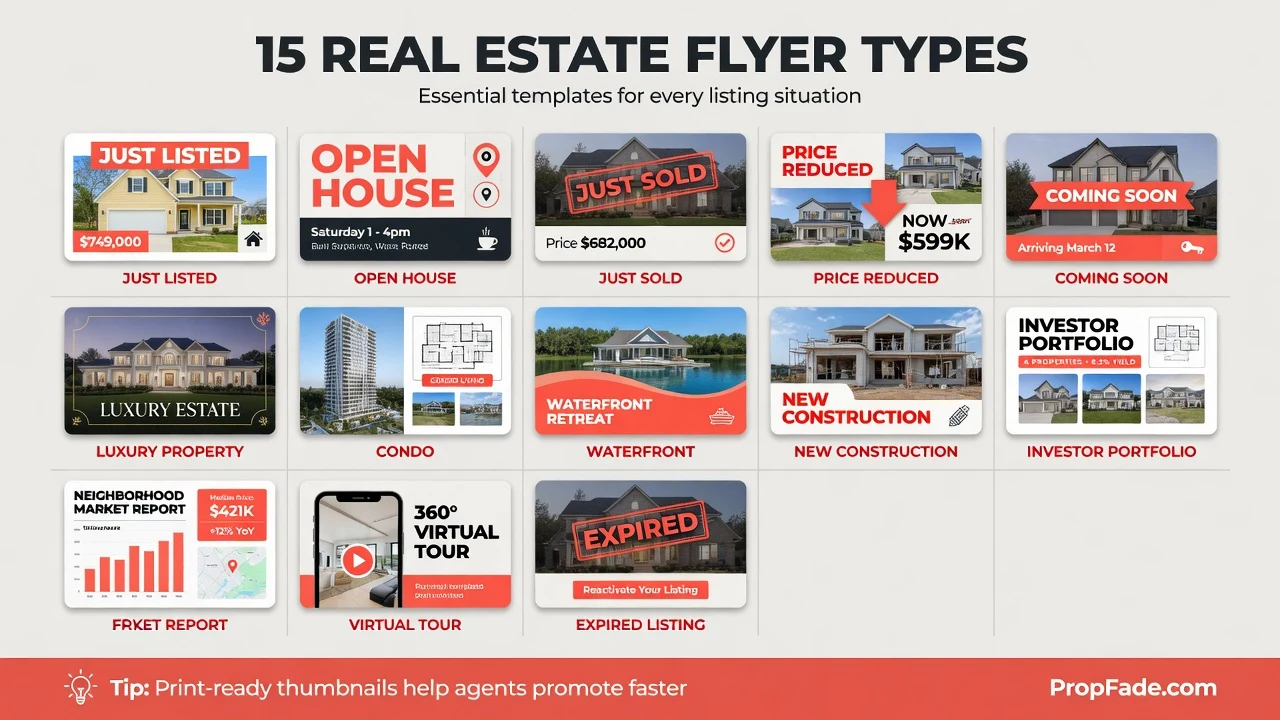
15 real estate flyer examples by type
The 15 most useful real estate flyer types are: just listed, open house, just sold, price reduced, coming soon, luxury property, condo, waterfront, new construction, investor portfolio, neighborhood market report, virtual tour, expired listing, seasonal, and agent branding.
1. Just Listed single-family flyer. The workhorse of listing promotion. It leads with the exterior photo at full width, then shows the price, bed count, bath count, and square footage in a clean spec bar below the image. The contact block with a QR code linking to the full listing sits at the bottom. Standard print size: 8.5 by 11 inches, portrait orientation.
Sample headline: “Just Listed on Willow Street: 4 Beds, 2 Baths, Corner Lot, $429,000” CTA wording: “Call [Agent Name] at [phone] or scan below for the full photo gallery” Layout note: Street name in the headline triggers immediate neighborhood recognition; the spec line pre-qualifies buyer interest before the reader reaches the body copy.
2. Open house event flyer. Built around two facts: the address and the date and time. The best open house flyers use a bright interior photo (kitchen or main living space), display the event details in a large, high-contrast block, and include a QR code linking to driving directions. A flyer posted within two miles of the property can draw walk-in traffic from neighbors who know potential buyers.
Sample headline: “Open House This Sunday, 1 to 4 PM, 78 Birch Lane” CTA wording: “Walk in or scan for driving directions” Layout note: Day-of-week before the date reads faster than a calendar date alone; “walk in” signals a low-commitment entry point for neighbors who want to browse without scheduling.
3. Just Sold social-proof flyer. Sends two signals to the neighborhood: you closed a deal, and the market is active. The sold price (or “above asking” if appropriate) goes front and center. A brief seller testimonial in two to three lines fits below the photo, and the layout closes with your headshot and direct contact. Distribute to surrounding streets within 48 hours of closing.
Sample headline: “Sold in 9 Days at $12,000 Over Asking on Cedar Court” CTA wording: “Selling nearby? Call [Agent Name] at [phone]” Layout note: Days on market and the premium together create a specific, verifiable proof point that a neighbor can compare against what they already sense about the market.
4. Price Reduced urgency flyer. Opens with the reduction amount in large type. A specific figure (“$20,000 price drop”) scans faster than a percentage because buyers think in dollars. Show the new price alongside the listing photo and spec bar. The visual contrast between the original price in smaller gray type and the new price in large bold type communicates motion without a word of persuasion.
Sample headline: “$20,000 Price Drop, Now Listed at $399,000, 218 Oak Avenue” CTA wording: “Schedule a showing before the weekend: [phone]” Layout note: Dollar amount before the new price creates a before-and-after contrast in a single line; the timeline CTA converts buyers who have already toured and are waiting for a reason to act.
5. Coming Soon pre-market flyer. Creates anticipation before the listing goes live. It shows the exterior or a strong interior detail, the neighborhood name, an approved price range, and a contact number for appointment scheduling. A firm go-live date gives buyers a concrete deadline to act on and consistently outperforms the vague “available soon” message. Use coming-soon flyers with written seller authorization, and confirm the approach against your local MLS rules, brokerage policy, and applicable advertising regulations before distributing, because pre-market rules vary by association and state.
Sample headline: “Coming Soon to Brookside Heights, Preview by Appointment Starting June 14” CTA wording: “Call [Agent Name] at [phone] to schedule a private preview” Layout note: A named neighborhood anchors the listing to a specific community identity; a firm go-live date creates a deadline that an open-ended teaser cannot replicate.
6. Luxury property large-format flyer. Uses wide margins, a full-bleed hero photograph, and restrained typography. Price appears near the bottom in an elegant serif font. Square footage, lot size, and two standout features (wine cellar, guest house, panoramic view) appear in a narrow detail strip. The agent headshot is small; the property is the brand.
Sample headline: “4,800 Sq Ft on the 17th Fairway, 9 Estate Lane, Offered at $2.4M” CTA wording: “Private showings by appointment: [agent email]” Layout note: Feature-first headline creates a distinctive image before the price arrives; “by appointment” signals exclusivity that matches buyer expectations in this price range.
7. Condo and townhome flyer. Highlights community amenities alongside unit specs, because condo buyers weigh the building as much as the unit itself. The layout typically splits into two columns: unit details on the left (beds, baths, HOA, parking), community features on the right (gym, pool, doorman, rooftop). Adding a small floor plan increases the time buyers spend reading the flyer.
Sample headline: “2 Bed Plus Den, Rooftop Pool, Steps to the Metro, The Landmark at 400 Park” CTA wording: “Book a tour this week: [phone] or scan the QR code” Layout note: Amenities before unit specs match the condo buyer’s evaluation order; transit proximity answers the commute question before the reader has to search for it.
8. Waterfront or view property flyer. Leads with the view in every case. A full-bleed horizontal photo of the water or skyline anchors the top third of the layout. Listing specs and contact information fall below it. The hero image does the persuading; the copy confirms the facts.
Sample headline: “Unobstructed Bay Views from Every Room, 14 Harbor Point Rd, 3 Beds, $875,000” CTA wording: “Schedule a showing: [phone]” Layout note: “From every room” is specific and verifiable; it distinguishes this listing from partial-view properties where only one room faces the water.
9. New construction builder partnership flyer. Co-branded with the builder’s logo alongside the agent contact. Architectural renderings or model-unit photography replace traditional listing photos. Pricing appears as “from $XXX,000” with a line on available floor plans or lot configurations. A QR code links to the community site plan.
Sample headline: “Reserve Now at Creekside Estates, Single-Family Homes from $520,000, Delivery Late 2027” CTA wording: “Scan for the site plan and available lots” Layout note: A delivery window gives buyers a concrete planning horizon; the QR-to-site-plan shortcut satisfies location-first buyers before they have to schedule a call.
10. Investor multi-property portfolio flyer. Presents two to four properties side by side in a data-dense grid: address, unit count, asking price, cap rate, and current occupancy. This format targets landlords and investors who evaluate deals in numbers, so the layout resembles a one-page investment summary rather than a marketing piece.
Sample headline: “Three Income Properties in the Millbrook Rental District, Cap Rates 6.2 to 7.4 Percent” CTA wording: “Email [Agent] for the one-page financial summary” Layout note: Cap rate range and a named submarket let an investor assess fit in seconds; a financial-download CTA positions the agent as organized before the first conversation.
11. Neighborhood market report flyer. Hyperlocal data for a specific ZIP code or named neighborhood, mailed to homeowners as a value-add. Shows median sold price, average days on market, number of homes sold in the period, and the agent’s own closed transactions in the area. Homeowners who see their equity rising call the agent who sent the data. Pair it with the real estate listing descriptions guide to add property-level copy to each outreach piece.
Sample headline: “Oakdale Neighborhood Market Update, March 2026” CTA wording: “See what your home is worth this month: [phone] or scan” Layout note: Named neighborhood and a recent month anchor the data to the reader’s own address; an equity-focused CTA works because homeowners reading rising prices are already thinking about valuation.
12. QR code virtual tour flyer. A print-to-digital bridge for buyers who cannot visit in person. The print side is a minimal single-photo layout with the full street address and a large, scannable QR code labeled “Scan for the 3D walkthrough.” The QR links to an interactive tour hosted online. This type performs well for out-of-area buyers who want to walk the property before traveling.
Sample headline: “Tour 27 River Street Before You Travel, Scan for the Full 3D Walkthrough” CTA wording: “Questions? Text [Agent] at [phone]” Layout note: “Before you travel” speaks directly to the out-of-area buyer; text as the contact method lowers friction compared to a phone call for someone evaluating a purchase from another city.
13. Expired listing prospecting flyer. Mailed to sellers whose listing lapsed with another brokerage. The layout centers on the agent’s track record in that area: closed transactions nearby, average days on market, and a concrete forward-looking offer such as a pricing review, a relaunch plan, or a market update tailored to their property. Use only claims that are factually grounded and compliant with your broker’s guidance; avoid buyer or offer representations that cannot be independently verified, as misrepresentation violates the NAR Code of Ethics and most state licensing rules.
Sample headline: “A Fresh Approach for 54 Elm Place: Pricing Review and a New Marketing Plan” CTA wording: “Call [Agent] at [phone], I closed three homes on this street in the past year” Layout note: Named address shows the agent did targeted research; nearby closings in the CTA are facts the homeowner can verify independently, which builds credibility before the first call.
14. Seasonal themed flyer. Adapts standard listing promotion to a seasonal hook. A spring flyer leads with garden and landscaping photography, a fall flyer shows warm interior light and a lit fireplace, and a winter flyer highlights proximity to ski terrain or community holiday programming. Seasonal flyers earn more social shares during the relevant months because the visual matches the reader’s current mindset.
Sample headline: “Spring Is Peak Selling Season in Lakeview, Start Your Listing Before the Rush” CTA wording: “Book a home valuation before June: [phone] or scan” Layout note: Anchoring timing to a season ties the deadline to external conditions rather than agent pressure; the named neighborhood confirms local knowledge.
15. Agent introduction and branding flyer. Distributed when joining a new market, a new brokerage, or a new farm neighborhood. Leads with a professional headshot, a two-sentence specialization bio, key metrics (total transactions closed, neighborhoods covered, years in the market), and a single call to action: a direct phone number or a calendar-booking link. Works as a door-hanger or a direct-mail piece.
Sample headline: “[Agent Name] Now Serving the Greystone Farms Neighborhood” CTA wording: “Call or text to talk about your home: [phone]” Layout note: A specific neighborhood replaces generic “area specialist” language; “talk about your home” is a lower-commitment ask than “list with me,” making cold outreach more likely to get a reply.
Why each real estate flyer type works
Three principles explain every effective real estate flyer: visual hierarchy (one dominant element pulls the eye), specificity (named facts over vague claims), and a single call to action per flyer (the reader does one thing or nothing).
Visual hierarchy. Every effective flyer has one dominant element: the exterior photo, the price reduction amount, or the event date and time. When two elements compete equally for attention, neither registers. The luxury flyer solves this by giving roughly 60 percent of the layout to the hero photograph, so the property communicates before the price does. For typography ratios and color contrast standards, the real estate flyer design guide covers the production specifics.
Specificity. A flyer that names the price, the street, and the square footage gives buyers a concrete reason to call. The market report flyer earns trust because the homeowner can verify the neighborhood data against what they already know. Specific numbers, named neighborhoods, and exact dates convert; broad descriptions do not give the reader a reason to act.
One action per flyer. Open house flyers ask the reader to attend. Just Sold flyers ask the reader to call about their own home. QR tour flyers ask the reader to scan. A flyer that asks for two different actions at once splits attention and reduces both response rates. Choose one action and design the entire layout toward it.
How we selected these 15 real estate flyer examples
These 15 types were chosen to cover every stage of the listing life cycle and every prospecting scenario, with no two types serving the same goal.
Selection came down to four criteria. First: distinct goal. Each type on the list serves a unique intent, so an agent can match a situation to a single flyer without weighing several overlapping options. Second: format-agnostic design. Each type works in print (8.5 by 11 inches), social media (1080 by 1350 pixels), and digital distribution (email attachment), so an agent distributing across all three channels can adapt the same underlying layout.
Third: shareability. Real estate flyers earn consistent organic sharing when they contain data or a time-sensitive offer that gives recipients a specific reason to pass them along. The market report and Just Sold types reliably earn the most peer distribution within a farming area. Fourth: reproducible without a designer. Each type builds from a real estate flyer template with standard fields and no custom illustration required.
An agent cycling through all 15 types across a year has a distribution-ready flyer for every week of listing activity, from new inventory announcements to post-close prospecting to seasonal content.
At-a-glance comparison: real estate flyer types by situation
This reference maps all 15 real estate flyer types to the situation they serve, the key elements each requires, and the distribution formats each suits.
| Flyer type | Best for | Key elements | Formats |
|---|---|---|---|
| Just Listed | New listing launch | Exterior photo, price, specs, QR code | Print, social |
| Open House | Event promotion | Date/time, interior photo, QR for directions | Print, social |
| Just Sold | Credibility and neighbor prospecting | Sold price, seller quote, agent contact | Print, mail |
| Price Reduced | Relaunching a stale listing | Reduction amount, new price, listing photo | Print, digital |
| Coming Soon | Pre-market buzz | Exterior or detail photo, firm go-live date | Social, mail |
| Luxury | Premium property listings | Full-bleed photo, restrained serif typography | Print, email |
| Condo/Townhome | Community-driven buyers | Unit specs, amenity list, optional floor plan | Print, email |
| Waterfront/View | Feature-led properties | Panoramic hero photo, brief spec bar | Print, social |
| New Construction | Builder partnerships | Renderings, from-$X pricing, QR to site plan | Print, digital |
| Investor Portfolio | Landlords and investors | Side-by-side grid, cap rate, occupancy | Print, email |
| Market Report | Seller lead farming | Median price, days on market, agent closings | Mail, digital |
| QR Virtual Tour | Out-of-area buyers | Single photo, large QR code, tour link | |
| Expired Prospecting | Sellers with a lapsed listing | Agent track record, nearby closings | |
| Seasonal | Time-of-year engagement | Seasonal photography, listing highlight | Social, mail |
| Agent Intro/Branding | New market or farm launch | Headshot, bio, key metrics, contact | Print, mail |
Common real estate flyer mistakes to avoid
The four most common real estate flyer mistakes are too much text, missing contact information, low-resolution photography, and using a generic layout across every listing type.
Too much text. A print flyer viewed at arm’s length holds attention for about three seconds. Paragraphs of body copy get skipped. Replace descriptive sentences with a spec bar (beds, baths, square footage, price) and a single standout line for the property’s best feature. Keep total copy under 80 words for print and under 50 words for social.
Missing contact information. Putting only a website URL and expecting the reader to navigate to a contact page costs responses. Every flyer needs a direct phone number and an email address visible without searching, plus a QR code as a fast-path option. When the contact path is one tap (a phone number or a QR code), response rates go up.
Low-resolution or poorly cropped photography. A blurry or undersized main photo signals lower quality before the reader processes any words. Print flyers require a minimum of 300 DPI at final size. Social media flyers perform best at 1080 by 1350 pixels. Crop the exterior shot so the home fills the frame with a sliver of sky and lawn, keeping the front door visible and centered.
Generic layout for every listing type. Using the same template for a Just Listed flyer, a luxury property, and an expired-listing prospecting piece sends the wrong signal to each audience. Luxury buyers expect white space and restraint; expired-listing sellers expect specific proof. A distinct template for each type, built from a real estate flyer template, makes each flyer more persuasive to its specific reader.
Turn your listing photos into a property video
The same listing photos that anchor a well-designed flyer can drive the digital side of the same campaign. A slideshow video editor animates each image with a slow pan or zoom, takes a recorded voiceover narrating the key features, and adds on-screen captions for sound-off viewing. The three export formats cover every placement: vertical 9:16 for Reels and Stories, square 1:1 for feed posts, and horizontal 16:9 for YouTube and listing sites. Canva and Adobe Express handle all three sizes (in Canva, resizing an existing project is a Pro feature), and CapCut covers the same range free with generated captions.
| Video format | Best placement | Use with the flyer campaign |
|---|---|---|
| 9:16 vertical | Instagram Reels, TikTok, Stories, YouTube Shorts | Post the same day the flyer drops so mobile viewers get the full animated walkthrough |
| 1:1 square | Facebook and Instagram feed | Pair with the flyer headline, price, and QR destination for feed scrollers |
| 16:9 horizontal | YouTube, listing page, email embed | Use as the long-form destination behind the flyer QR code or email thumbnail |
A practical sequence: post the property video to your social profiles the same day your flyer distributes to the neighborhood. Buyers who receive the flyer see a print summary; buyers who scan the QR code or find the social post get the full animated walkthrough. The two formats reinforce each other without creating separate production work.
Frequently asked questions
Good real estate flyer examples include: a just-listed flyer with the exterior photo, price, and spec bar; an open house flyer with the address and event date in bold; a just-sold flyer with the sold price and a brief seller testimonial; and a neighborhood market report flyer with median price and average days-on-market for local homeowners. Each type solves a single goal and includes a clear contact path.
A good listing flyer has one dominant photo (the exterior or the best interior room), a spec bar showing beds, baths, square footage, and price, a single standout feature in one short line, and a contact block with a phone number, email, and QR code. The total copy stays under 80 words so the flyer reads in under ten seconds at arm's length.
An open house flyer should include the full street address, the date and time of the event, at least one interior photo (the kitchen or main living space), the agent name and direct phone number, and a QR code linking to driving directions or the full listing. If parking is limited in the neighborhood, add a brief note on where to park.