
Getting real estate clients comes down to three levers: warm outreach to your sphere, a content habit that keeps your name visible, and a consistent follow-up system. A new agent who works all three can book a first consultation within 30 to 60 days.
This guide gives you the specific tactics, a 30-day client-getting checklist, and five copy-paste prospecting scripts. Each asset can be used today without a big budget, an existing client roster, or a large social following. For the broader first-year picture, the new real estate agent advice guide covers the full roadmap.
Get your first real estate client: sphere, niche, and partnerships
Your sphere of influence is the fastest path to a first real estate client. Text or email everyone you know, announce your license directly, and end with one specific question about their real estate plans.
Per the NAR 2025 Member Profile, 21 percent of agent business comes from past-client referrals, and that share rises to 28 percent for agents with 16 or more years of experience. Starting with people who already trust you is the highest-return activity in your first 90 days.
Build and contact your sphere list
Write down every person you know: family, close friends, former coworkers, college contacts, neighbors, gym regulars, and social media connections. A working list of 100 to 200 names is realistic for most new agents.
Contact each person with a personal message. A short text works for close contacts; a short email works for professional ones. Aim for 10 to 15 personal messages per day until you have reached everyone on the list. A personal note converts better than a mass announcement because it reads as a conversation, not a broadcast.
Pick a niche to make yourself referable
A niche makes you easier to recommend. Common starting choices include first-time buyers in a specific neighborhood, a price band (condos under $400K, for example), a property type (new construction, investment properties, or condos), or a buyer demographic (relocating professionals or downsizing retirees).
Niche positioning sharpens your real estate slogans, bio, and social presence. An agent described as “the first-time buyer specialist in River North” is a more specific referral than a generalist. That specificity makes it easier for contacts in your sphere to pass your name to someone who needs you. The how to market yourself as a new real estate agent guide covers how to turn your niche into a visible brand.
Build referral partnerships with complementary professionals
Referral partners send warm leads without an ad budget. A mortgage lender who closes 15 to 20 loans a month works with buyers who still need an agent. A divorce attorney handles clients in transition who frequently need to sell and rebuy. A relocation coordinator places incoming employees who need a local agent within weeks.
Reach out to three to five complementary professionals each month. Lead with value first: share a market data update with a lender, refer an interested seller to a staging specialist, or co-host a first-time buyer seminar with a mortgage broker. One productive referral partnership can generate one to two closed deals per year.
Expand reach with open houses and geographic farming
Hosting open houses for a colleague’s listing puts you in front of active buyers who have not yet chosen an agent. Collect contact information, ask about timeline and criteria, and follow up within 24 hours using the scripts below.
Geographic farming builds a medium-term pipeline. Choose a neighborhood of 300 to 500 homes, mail a market update every 4 to 6 weeks, and track responses over 12 to 18 months. Agents who farm a defined area consistently for 18 months typically capture 5 to 10 percent of the listing activity in that area. For a detailed prospecting approach, the how to get leads as a new real estate agent guide covers farming, door-knocking, and digital lead capture together.
30-day client-getting checklist (copy this)
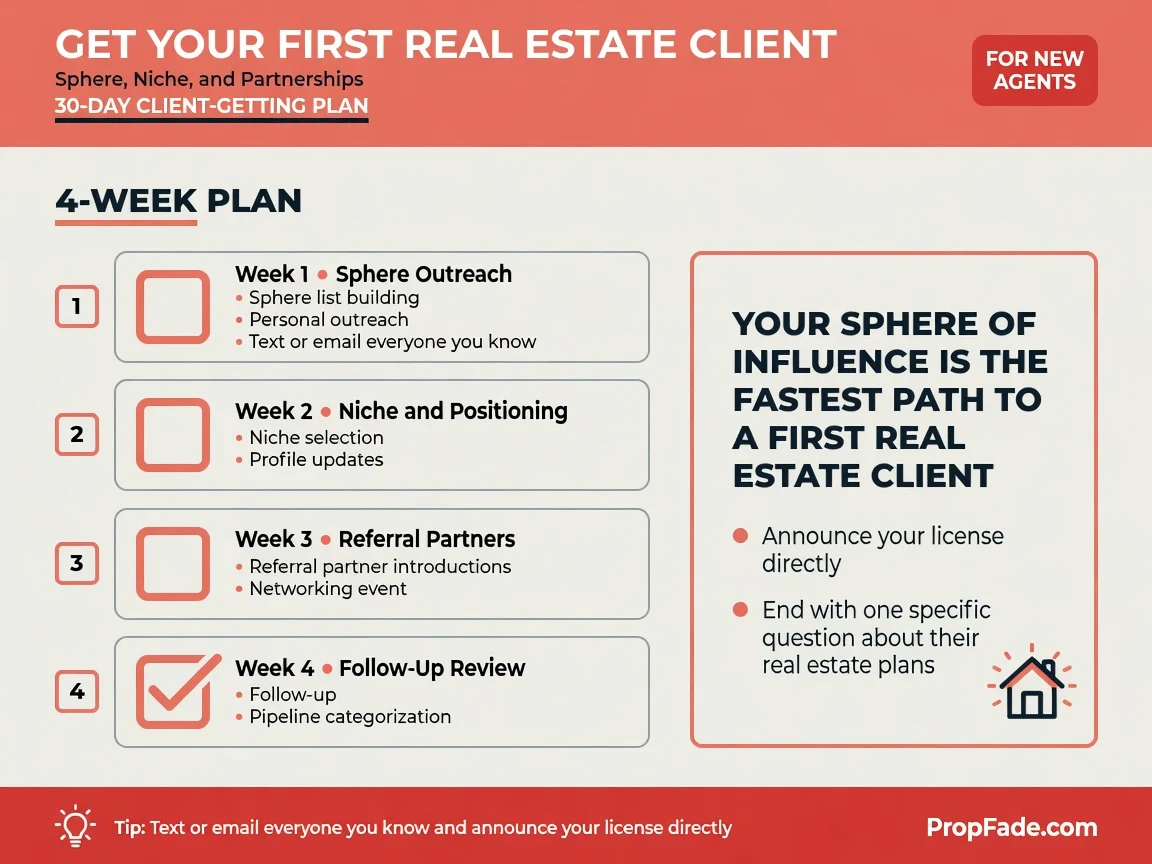
Week 1: Sphere outreach
- Write your full contact list (aim for 150 names minimum)
- Send 10 to 15 personal texts or emails per day from that list
- Post a “just licensed” announcement on LinkedIn and Instagram
- Schedule one-on-one calls or coffee with 3 close contacts who might know buyers or sellers
- Ask your broker about any unassigned or reassigned leads in the office system
Week 2: Niche and positioning
- Name one niche (a neighborhood, a buyer type, or a property type you know well)
- Update your bio on your brokerage profile, Zillow, and your social pages
- Choose 3 to 5 zip codes to track weekly for new listings and price changes
- Set up Google Alerts for your target area (new listings, price reductions, local news)
Week 3: Referral partners
- List 10 professionals who serve buyers or sellers without competing with you (lenders, attorneys, inspectors, stagers, movers, accountants)
- Reach out to 3 of them this week with a brief introduction by phone or email
- Attend one local professional event (chamber of commerce, BNI chapter, or investor meetup)
Week 4: Follow-up
- Follow up with every sphere contact who replied or expressed interest
- Reconnect with anyone who went quiet after your first message
- Categorize your pipeline by timeline: 30-day, 60-day, and 90-day leads
- Set a monthly recurring reminder to send a value-add to every inactive contact
Attract real estate clients with video and social content
Listing videos and social posts attract clients who do not know you yet. Listings with video generate 403 percent more inquiries than listings without, and 73 percent of homeowners prefer agents who use video.
According to the NAR Technology Survey, 75 percent of Realtors use social media, and 39 percent name it their top lead-generating technology. The gap between agents who grow from content and those who do not is consistency and specificity, rarely budget.
Post listing videos on every property you represent
A 30-to-60-second vertical listing video outperforms a photo grid on every social platform because buyers forward video to partners, parents, and friends. One listing produces three cuts: a 9:16 vertical Reel for Instagram and TikTok, a 1:1 square cut for the feed, and a 16:9 horizontal cut for the listing page and email.
Every listing video is a piece of content that works after hours and beyond your zip code. Buyers who watch your video and book a showing are already warmed up before they call you. Over time, a consistent video library builds recognition with people who have never met you.
Create listing videos from photos
A slideshow video editor converts your listing photos into formatted listing videos without filming. Pick 12 to 20 photos, sequence them in the order a buyer walks the home, animate each with a slow pan or zoom, record a short voiceover from the listing facts (or let captions carry them), and export all three formats from one project.
The ai real estate video editor guide explains the full editing workflow and compares the tools that handle each step. For agents listing multiple properties per month, the photo-to-video path removes the need for a videographer on every property.
Upload 12 to 20 listing photos
Start with the same photo set you already own or have licensed for the listing, then order the images the way a buyer would walk the home.
Sequence the buyer path
Open with the exterior, move through the strongest living spaces, and end on the feature that creates the clearest inquiry hook.
Add voiceover and captions
Use the listing facts to create a short narration or caption track that names the price, location, bed count, and standout feature.
Export all three formats
Save a 9:16 Reel, a 1:1 feed cut, and a 16:9 listing-page version from the same project.
Build a weekly content habit that compounds
A three-post week is sustainable and sufficient to keep the algorithm and your audience engaged. One listing video on Monday, one market update or neighborhood highlight on Wednesday, and one personal or community post on Friday produces 12 posts per month without burnout.
Reply to every comment within the first hour after posting. Early engagement signals quality to the platform and expands reach at no added cost. A content habit maintained for 90 days builds the kind of consistent visibility that sphere outreach alone cannot create.
Real estate prospecting scripts you can copy and send today
The most direct path to a client is a direct ask. These five scripts cover sphere outreach, warm follow-ups, referral partner introductions, and geographic farm outreach. Each ends with one specific question, because scripts that ask for something concrete generate more replies than scripts that trail off.
Personalize the name and the market context. Keep the core structure intact.
Real estate prospecting scripts
Script 1: Sphere announcement (text or iMessage)
Hi [Name], quick note: I just got my real estate license and I'm working with [Brokerage] in [Market]. If you or anyone you know is thinking about buying or selling in the next 6 to 12 months, I'd love to be your first call. Any real estate plans coming up?

Script 2: Sphere announcement (email)
Subject: I'm now a licensed real estate agent
Hi [Name],
I wanted to share that I recently got my real estate license and I'm now working with [Brokerage Name] in [Market].
I'm building my client base and your referrals mean a great deal at this stage. If you or someone in your circle is thinking about buying, selling, or investing, I'd love to connect.
Are you planning any real estate moves in the next year? Even if the timing is 12 months out, I'd love to be your resource.
Best,
[Your Name] | [Phone] | [Website]

Script 3: Warm follow-up
Hi [Name], hope things are good. I wanted to check in since we haven't talked in a while. I've been busy building my real estate business in [Market]. Are you still in [City]? Any real estate moves on the horizon this year?

Script 4: Referral partner introduction
Hi [Name], I'm [Your Name], a real estate agent with [Brokerage] in [Market]. I came across your work and think we serve a similar client. I'd love to grab coffee and see if there's a fit for trading referrals. Do you have 20 minutes in the next couple of weeks?

Script 5: Neighborhood farm outreach
Hi, I'm [Your Name] with [Brokerage]. I specialize in this neighborhood and I'm currently working with [N] active buyers. I wanted to introduce myself in case you're considering selling in the next 6 to 12 months. Would you like a current market snapshot for your home?
Follow-up cadence that keeps leads active
Most buyer leads act 3 to 6 months after first contact, and many seller leads take 12 months or longer. A structured cadence keeps you in front of prospects until their timing aligns with yours.
Use this schedule for every lead who does not commit immediately: Day 3 (a brief check-in note), Day 10 (send a relevant new listing or market update), Day 30 (a direct follow-up by phone or text), and monthly from that point with a value-add (a market report, a neighborhood stat, or a listing that fits their criteria). At the monthly stage, shift from asking to sharing. The agent who adds value on a consistent schedule wins the call when the prospect is ready.
Frequently asked questions
Start with your sphere of influence: text or email everyone you know, announce your license plainly, and end with one specific question about their real estate plans. The NAR 2025 Member Profile reports that 21 percent of agent business comes from past-client referrals. Pair sphere outreach with listing video content on social media and a structured monthly follow-up cadence to build pipeline beyond your warm network.
Contact your sphere first. Write a list of 100 to 200 people you know, send personal messages using the scripts above, and follow up with anyone who expresses interest. A new agent reaching out to their sphere daily can book a first consultation within 30 to 60 days. Hosting open houses for a colleague's listings also puts you face to face with active buyers who have not yet chosen an agent.
New agents find clients through sphere outreach, referral partnerships with lenders and attorneys, listing video content on social media, open houses, and geographic farming. Video content extends reach beyond your warm network: a listing video on Instagram or TikTok introduces you to buyers and sellers who have never met you, and each video works on its own schedule after it is posted.