
The agents who build lasting careers in real estate treat the business like a business from week one. That means choosing the right brokerage, building contact systems early, and prospecting before they feel ready.
This guide gives you a first-90-days action plan, a breakdown of the pitfalls that end new careers early, and the daily habits that compound into a sustainable business. Every section is copy-paste-ready so you can start today.
First 90 days: your action plan as a new real estate agent
The first 90 days break into three phases: days 1 to 30 to build your foundation, days 31 to 60 to generate your first real conversations, and days 61 to 90 to pursue your first deal or listing.
Move through the phases in order, because the work in each phase depends on the systems you build in the phase before it.
Days 1 to 30: build the foundation
Your brokerage choice has more impact in year one than your commission split. A brokerage with structured training, an assigned mentor, and floor duty gives you deal exposure and education while you are building your own pipeline. Interview at least three brokerages, ask each one how many deals the average first-year agent closes, and choose the one that gives you access to a producing mentor.
Set up a CRM in your first week. A contact database is the most valuable asset a real estate agent builds over a career. Start with everyone you know: family, friends, former colleagues, neighbors, and people from every community group you belong to. Aim for 200 contacts minimum in your first 30 days.
Add notes on each contact: when you last spoke, what they said about housing, and when to follow up. Those notes make follow-up specific and specific follow-up converts.
Begin light sphere outreach in week one. A short personal message to the people you know well, letting them know you earned your license and are building your business, starts conversations before you have polished scripts. This early outreach is what you will ramp into the full contact routine by day 31.
Publish your professional profiles while your contact list is growing. Complete your Zillow and Realtor.com profiles, set up a Google Business Profile, and write a real estate bio that leads with your local market focus. Many new agents delay the bio until they have transactions to show, but an early bio creates a professional impression from your very first contact.
Establish your brand basics in the first two weeks: a professional headshot, a consistent email signature with your license number and brokerage name, and a real estate slogan that fits on a sign rider and in a social bio. These take a few hours to set up and pay dividends on every future introduction.
Before any profile or marketing material goes live, run it by your broker for approval. Most states require your license number and brokerage name on all advertising, including social profiles and listing videos. When you start outreach calls and texts, verify you are following your brokerage’s prospecting guidelines and the national Do Not Call rules. Fair Housing requirements apply to every communication you send, including social posts and listing descriptions. These are quick, one-time checks that protect your license from the start.
Days 31 to 60: generate your first conversations
By day 31, ramp your outreach to 10 contacts per day, five days a week, building on the light sphere conversations you started in week one. That is 200 contacts in a single month, using phone calls, texts, DMs, door knocking, and open house conversations. The type of outreach matters less than the consistency.
Shadow your broker or the brokerage’s top agent on listing appointments and buyer consultations. Many experienced agents will allow a new agent to observe when you ask clearly, show up prepared, and confirm with your broker that the clients have been introduced to you beforehand.
Attend open houses in your target area, both as a visitor and as a host. As a visitor you see what other agents do well. As a host you meet buyers face to face and add every contact to your CRM that same evening.
This is also the right time to build your content presence. Learning how to market yourself as a new real estate agent covers the full channel mix, from social video to email to direct mail, so you can choose the one or two channels you will do consistently from the start.
Days 61 to 90: pursue your first deal or listing
Work every lead you generated in month two. Most deals in a new agent’s first year come from people who already know them, so sphere outreach is your most reliable source at this stage.
Ask for referrals directly. Tell your sphere that you are building your business and that a referral is the best way they can support you. Be specific: “If you know anyone thinking of buying or selling in the next six months, an introduction would mean a lot to me.”
Track your funnel numbers each week: contacts made, appointments set, offers written, and deals pending. These numbers show you exactly where the bottleneck is. Low appointments mean outreach volume is too low. Low offers mean you need more time on active showings.
The new real estate agent onboarding checklist covers the licensing, MLS, and brokerage paperwork steps that run alongside all three phases.
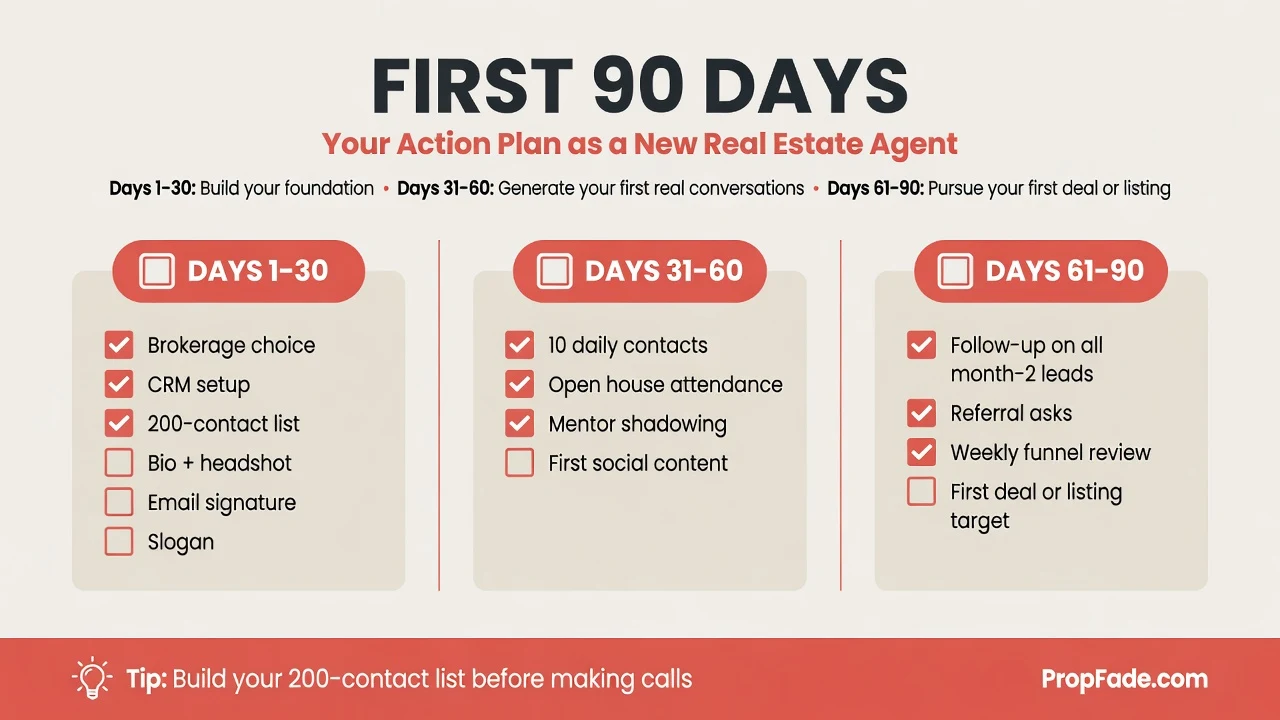
Copy-paste: first-90-days checklist
Days 1 to 30 (foundation):
- Interview three or more brokerages and choose one with mentorship
- Complete licensing paperwork and brokerage onboarding
- Join the MLS and local Board of Realtors
- Set up a CRM and add 200 or more contacts from your personal network
- Begin light sphere outreach in week one: a short personal note to your closest contacts
- Have your broker review your first scripts, profiles, and marketing materials before they go live
- Publish your agent bio on Zillow, Realtor.com, and Google Business
- Get a professional headshot taken
- Write your email signature with your photo, license number, and brokerage name
- Choose a slogan and use it consistently across every profile
Days 31 to 60 (first conversations):
- Make 10 outreach contacts per day, five days a week
- Attend at least one open house per week, as visitor and as host
- Shadow your broker on two listing appointments and two buyer consultations
- Post your first intro or listing content on social media
Days 61 to 90 (first transactions):
- Follow up with every lead you generated in month two
- Ask your five closest contacts for a direct referral
- Review your weekly funnel numbers every Friday
- Close your first deal or sign your first listing
Mistakes that derail new real estate agents in year one
The four most damaging first-year mistakes are waiting to prospect, underestimating startup costs, choosing a brokerage on commission split alone, and spending on paid leads before your personal sphere is fully worked.
Each one is avoidable once you know it is coming.
Waiting to prospect
New agents often delay outreach because they want to finish more training, learn more scripts, or close a first deal before “officially” launching. This is the single most expensive mistake in real estate, because your pipeline reflects work you did 60 to 90 days ago. Start contacting people in week one, even if your only script is: “I just got my license and I am building my business. Do you know anyone thinking of buying or selling?”
The how to get leads as a new real estate agent guide covers every source in depth: sphere, open houses, geographic farming, referrals, and online lead platforms.
Underestimating startup costs
Many agents pay most of their business costs before they earn a dollar. Common first-year expenses include MLS dues, Board of Realtors membership, E&O insurance, lockbox fees, business cards, sign riders, and basic marketing materials. Plan for these costs before your license is active, and keep six months of living and business expenses in reserve, because first transactions commonly take two to four months from first contact to close.
Choosing a brokerage on split alone
A 70/30 split at a brokerage with strong mentorship and deal flow produces more income in year one than an 80/20 split where you are operating without support. Commission split matters more in years two and three, once your pipeline is self-sustaining. In year one, training, floor duty access, and a producing mentor are worth more than a few extra percentage points on each commission.
Ignoring follow-up
Most real estate transactions begin with a conversation that goes quiet for weeks or months before the buyer or seller is ready. New agents often move on when a lead does not convert immediately. Build a simple follow-up sequence: warm leads every two weeks, cool leads every 30 days, dormant leads every 90 days. A CRM that generates this list automatically keeps every contact visible and prevents deals from slipping through.
Spending on paid leads before exhausting sphere
Paid leads from real estate portals can work, but they are expensive and highly competitive on a per-close basis. Many new agents spend on paid leads while warm contacts in their CRM go uncontacted. Work every person in your sphere at least twice before purchasing a single paid lead, and you will spend far less to close your first five transactions.
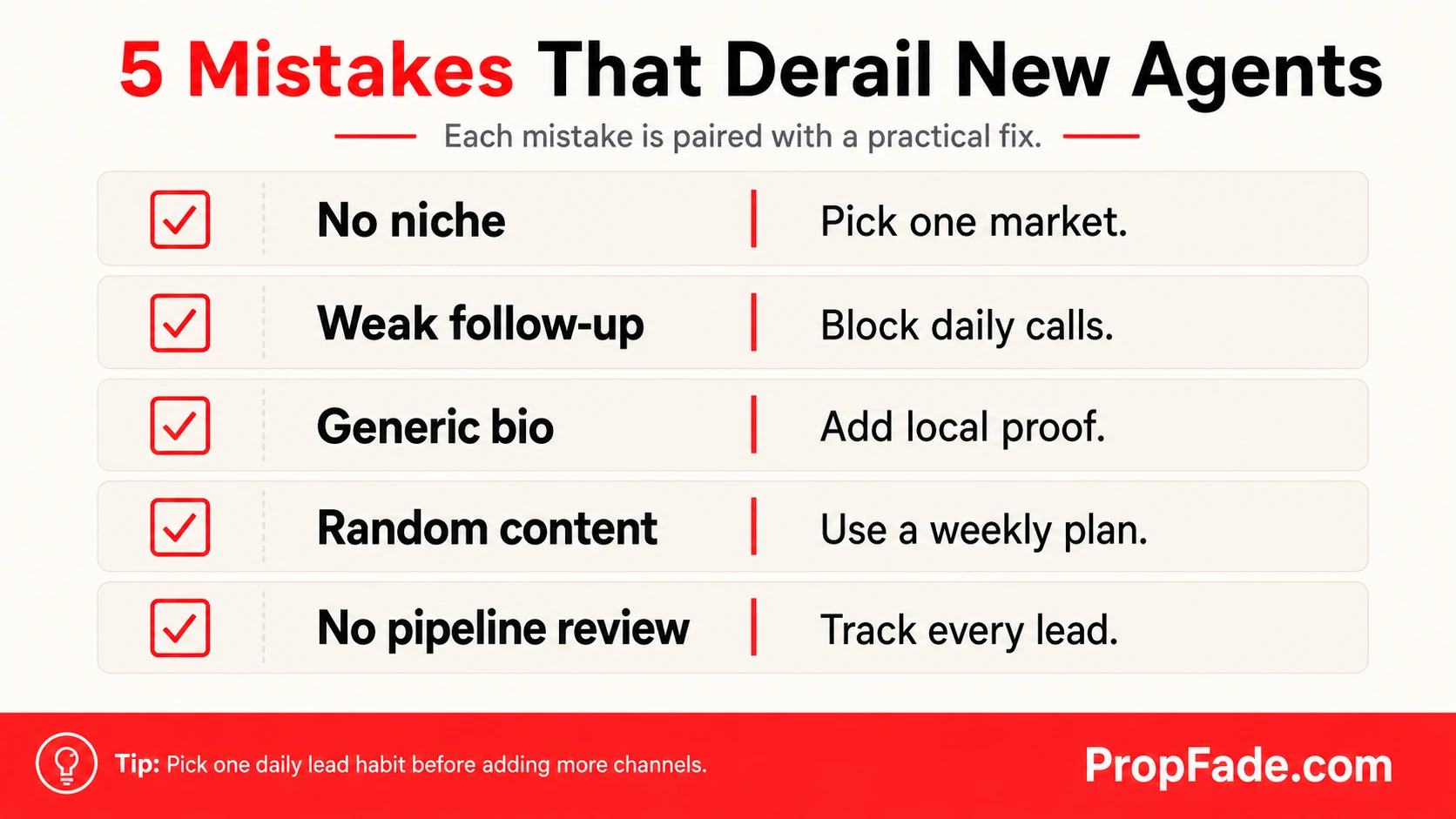
Daily habits that compound into a real estate career
Top producers share three non-negotiable habits: they prospect at a fixed time each day, they follow up with every lead on a schedule, and they review their pipeline numbers every week to catch problems early.
Start all three habits in your first month and protect them from the schedule pressures that come as your business grows.
Prospect at a fixed time each day
Block your prospecting hours before the week starts and protect that block like a showing appointment. Most top producers prospect in the morning, before other tasks consume the day, because call-pickup rates are higher and decision-making energy is fresh. Make the time non-negotiable for your first six months, even on slow weeks, because the habit builds the skill.
Set a daily contact goal and track it. Ten contacts a day adds up to 200 a month and more than 2,400 a year. Over three years, that is a database of people who have heard from you recently and consistently. Many early contacts refer you to buyers and sellers years later, compounding the initial work many times over.
Follow up on a schedule
Many buyers and sellers take 60 to 180 days from first conversation to signed contract. Build a follow-up sequence in your CRM and let it generate your daily call list automatically. Personalize each follow-up with one detail from the last conversation: “Last time we spoke you mentioned waiting until spring. Are you still planning a move?” This approach converts at a much higher rate than a generic market update email.
Mark every contact with a follow-up date at the end of each conversation, before you close the notes. That single habit prevents the most common new-agent failure: a lead that simply aged out because nobody remembered to call back.
Review your pipeline numbers every week
Spend 20 minutes every Friday reviewing your pipeline: contacts made this week, appointments set, active buyers, active sellers, deals pending, and projected close dates. This review shows you whether you are on pace for your income goal before the shortfall compounds. If appointment volume drops two weeks in a row, adjust the outreach before the month ends.
Write a one-line note on each active client: what stage they are at, what their next decision is, and what they need from you. These notes prevent deals from stalling because a follow-up fell off the radar.
Build your visual brand with listing videos from day one
One of the fastest ways to look established as a new agent is professional listing video on your first properties. A slideshow video editor takes your listing photos and renders a finished video with animated motion, voiceover, captions, and music, in three formats: 9:16 for Reels and TikTok, 1:1 for the feed, and 16:9 for your listing page. A new agent gets polished output close to a team with a production budget, from the very first listing.
Stack new habits on existing routines
Attach each new habit to something you already do. Prospect right after your morning coffee. Update your CRM notes right after each showing while the details are fresh. Run your weekly review every Friday before you close the laptop. Habit stacking reduces the daily decision load and keeps the routines running even on slow weeks.
Each habit compounds on the others. Consistent prospecting fills the pipeline. Systematic follow-up closes the deals in the pipeline. Weekly reviews show you when to press harder and when to adjust. Agents who do all three, every week, for two or three consecutive years build businesses that generate income from referrals and repeat clients without depending on paid leads.
Frequently asked questions
Choose a brokerage with mentorship over one with a higher commission split, start prospecting in week one before you feel ready, build your CRM from day one and add everyone you know, and review your pipeline numbers every Friday. Agents who treat the business like a business from week one are the ones still producing in year three.
Choose your brokerage, set up a CRM, and add every contact you know, aiming for 200 or more people in the first 30 days. Start light sphere outreach in week one and ramp to 10 daily contacts by day 31. Those two steps, done consistently, produce more first-year results than any other action.
New agents succeed by building three habits early: daily prospecting at a fixed time, systematic follow-up on every lead, and a weekly review of pipeline numbers. Agents who do all three consistently for two or more years tend to build a self-sustaining business driven by referrals and repeat clients.