
Real estate social media builds your name before buyers and sellers know they need you. This guide gives you platform choices, a copy-paste profile setup checklist, 10 post ideas to start today, and a weekly cadence you can maintain without burning out.
Social media for real estate, explained
Three platforms drive most agent results: Instagram for listings, Facebook for local community reach, and TikTok for short video tours. Choose two to start, post consistently, and add a third once the first two run on autopilot.
Real estate social media works because buyers spend roughly two hours a day on social platforms and often discover a neighborhood or an agent before opening a listing portal. An agent who posts weekly listing videos, market updates, and neighborhood clips builds mindshare that paid ads rarely match.
A practical anchor for the whole week is one listing video. A single recording session produces a 9:16 vertical reel for Instagram and TikTok, a 1:1 square for the feed, and a 16:9 landscape cut for YouTube or your listing page. Market updates, neighborhood clips, and client tips then distribute around that video anchor throughout the week.
The platforms differ by content type. Instagram rewards photo carousels and short vertical video. Facebook rewards community posts, event listings, and shares into neighborhood groups. TikTok rewards raw, authentic short video, and listings filmed in one take often outperform polished production. LinkedIn generates referrals from other professionals rather than direct buyer leads.
On Instagram, Reels tend to reach significantly wider audiences than static photo posts, and most major platforms give short video an organic discovery advantage over static images. Agents who anchor their weekly posting mix with one listing reel tend to see the fastest early growth in follower count and profile visits.
Explore the real estate social media marketing hub for a full platform-by-platform breakdown and a channel map for each stage of your business.
Set up your real estate social media profiles correctly
A clear, consistent profile tells a new viewer who you serve, where you work, and how to reach you in under five seconds. Four elements decide whether they follow or leave: your photo, your bio, your link, and your handle.
Use a professional headshot as your profile photo on every platform. Buyers hire a person, and a face photo builds recognition faster than a brokerage logo. Keep the same headshot across all platforms so a viewer who finds you on Facebook recognizes you immediately on Instagram.
Write your bio around two facts: the city or metro you serve and the buyer or seller type you specialize in. “Austin REALTOR helping first-time buyers close without the stress” communicates more than “Passionate real estate professional serving all your needs.” Instagram caps bios at 150 characters; Facebook page descriptions allow up to 255.
Use one link in your bio to the highest-value destination: your listing page, a home valuation tool, or a direct booking link. A link aggregator lets you track which platform sends the most traffic.
Match your handle to your name wherever possible. A handle built from your name is easier to find and remember than a generic phrase like “austin_real_estate_deals_2026.”
| Profile element | Optimized setup | Basic setup to avoid |
|---|---|---|
| Profile photo | Current professional headshot that makes the account feel personal and reachable | Logo-only photo that hides the person behind the account |
| Bio | Clear service-area bio with city, specialty, and one action such as book a call or view listings | Generic real estate slogan with no location or next step |
| Link | Single link to listings, booking, or a contact page that matches the current campaign | No link, broken link, or a link that sends visitors to a cluttered home page |
| Story highlights | Four simple covers labeled Listings, Sold, Neighborhood, and About Me | No highlights or unlabeled highlights that make past content hard to scan |
Profile setup checklist (copy and use):
- Profile photo: professional headshot, same image across all platforms
- Display name: your real name, plus brokerage if required by your license
- Bio: city served, buyer or seller specialty, and one clear action phrase
- Link: home valuation page, listing page, or direct contact or booking link
- Contact button: phone and email visible on your Facebook business page
- Handle: your name, not a generic keyword phrase
- Story highlights (Instagram): Listings, Sold, Neighborhood, About Me
- Profile category: Real Estate Agent on both Instagram and Facebook
Before publishing to any platform, verify your state’s advertising requirements. Most states require your license number and brokerage name to appear in real estate social content. Fair housing law prohibits language that expresses a preference or limitation based on race, religion, national origin, disability, familial status, or other protected characteristics. If you use a photographer’s listing photos, confirm your usage rights before reposting. For client testimonials and success stories, get written consent first.
Your first 10 posts on real estate social media
Cover three buckets in your first 10 posts: active listings, market data, and yourself as a local expert. This mix shows the algorithm what you do and shows potential clients that you know the area.
You do not need to be creative from scratch every week. A rotating content framework handles the creative decisions so you focus on capturing the content. Start with 10 post types you can build from what you already have.
10 posts to start with
- **Just listed:** Photo carousel with price, beds, baths, one standout feature, and a booking link.
- **Just sold:** Sold card over the listing photo with the result delivered.
- **Market update:** One local stat with a plain-language takeaway.
- **Listing reel:** A 30 to 45-second vertical video tour.
- **Neighborhood feature:** One local spot with a photo and two sentences on why buyers love the area.
- **Agent intro:** A 30-second face-to-camera video with city, specialty, and personal context.
- **Buyer tip:** One specific, actionable piece of advice.
- **Testimonial:** A specific client quote over a photo of the home.
- **Behind the scenes:** One photo from a showing, staging prep, or open house setup.
- **Open house invite:** Date, time, address, and a photo of the home.
For over 100 ready-to-copy captions across every post type, see the real estate social media posts library.
Common real estate social media mistakes and how to fix them
Four mistakes stall most new agents: posting fewer than twice a week, skipping video, writing captions for the wrong audience, and treating Instagram the same as Facebook. Each has a one-step correction.
Posting too rarely. Platforms reward accounts that post consistently. An agent who posts once a week stays visible; one who disappears for three weeks loses algorithmic reach and has to rebuild it. Aim for at least three posts per week, even if some are reposts of evergreen content from earlier in the year.
Skipping video. Short video typically reaches a wider organic audience than a static post on most major platforms. A 30-second phone tour of a listing, filmed in one take and posted as a reel, outperforms a polished six-photo carousel for new-account discovery. Start with one video post per week and build from there.
Writing captions for sellers, not buyers. “Beautiful kitchen with quartz counters” describes a feature. “This kitchen is why the sellers raised two kids here and never wanted to leave” gives a buyer a reason to care. Write to the emotion first, then include the spec facts.
Treating every platform the same. Instagram rewards aesthetic consistency and hashtags. Facebook rewards shares into local community groups and event posts. TikTok rewards raw authenticity and direct talking-to-camera style. Copying the same caption to all three without adjustment lowers reach on each platform.
A quick content audit takes five minutes: look at your last 10 posts and count how many include video, how many include a local fact, and how many have a clear next step in the caption. Those three numbers tell you exactly where to adjust first.
Real estate social media examples, annotated
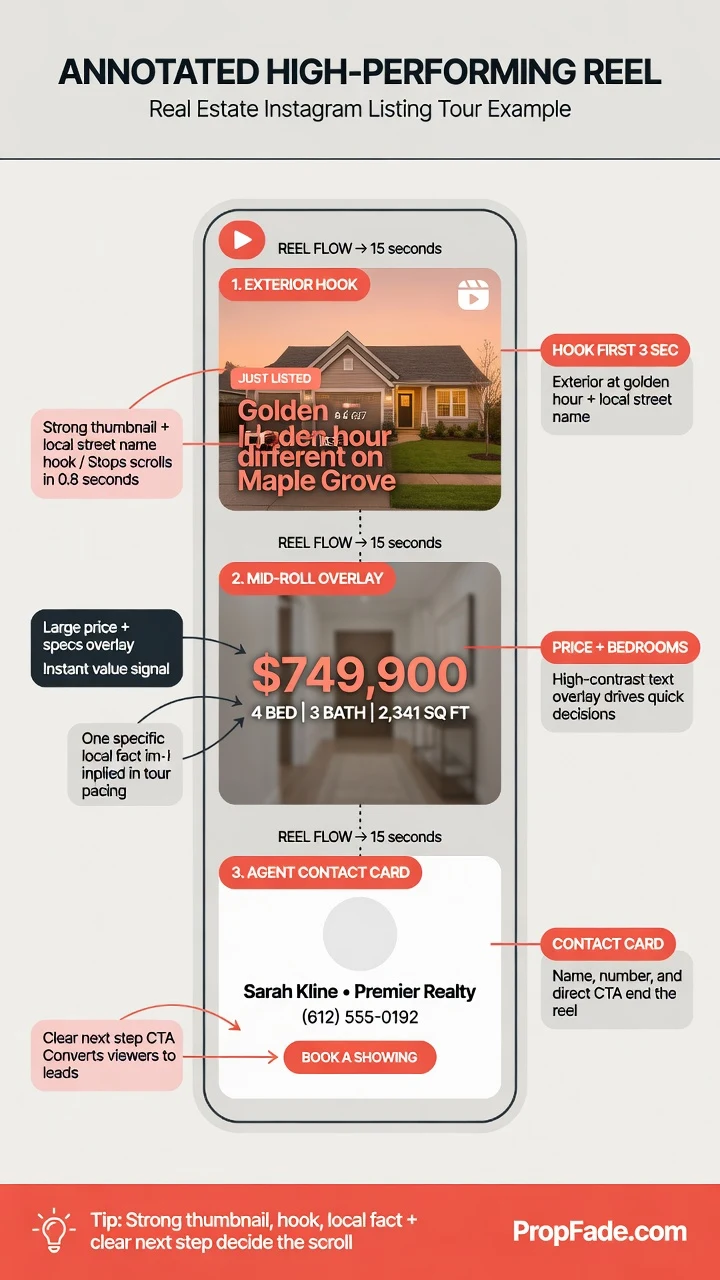
A high-performing real estate post combines a strong thumbnail or cover image, a hook in the first sentence, one specific local fact, and a clear next step. Those four parts decide whether a viewer stops scrolling or keeps going.
Listing reel example. A 30-second vertical video opens on the exterior at golden hour, cuts through five rooms with a slow walk-through move, overlays the price and bedroom count in large text at the five-second mark, and closes with the agent’s name and a booking call to action. The caption opens with “Four bedrooms, three minutes from the elementary school, and under $500k” rather than the street address.
Market update post example. A single graphic shows one stat (“Days on market: 9, down from 22 last year”) over a clean background with the neighborhood name. The caption explains what the number means for a buyer in that zip code, then asks a question to drive comments. This format earns more shares than a typical listing post because it delivers value to everyone in the area, whether or not they are actively searching.
Neighborhood reel example. A 20-second video shows a local coffee shop, a park, and a school in a quick montage. The caption names the neighborhood, lists the average sale price range, and links to active listings. This format reaches non-follower viewers because Instagram and TikTok both use location signals to surface neighborhood content to nearby accounts.
An ai real estate video editor can batch-apply consistent text overlays, captions, and branding across a full month of listing content in one session, so the visual style stays identical from listing to listing.
Build a posting habit: cadence, batching, and your first listing reel
Consistency matters more than production quality in the first 90 days. Post three times per week on Instagram and twice on Facebook, batch a full month of posts in one afternoon, and anchor each week with one listing video.
A batching session once or twice a month removes the daily “what do I post?” friction. Set aside two hours, gather your listing photos, pull the month’s market stats, and write captions for all 10 to 15 posts at once. A scheduling tool then auto-publishes them throughout the month so you post consistently with no daily effort.
Anchor each week with one piece of video content. A listing reel posted on Tuesday or Wednesday tends to catch a strong mid-week engagement window on both Instagram and Facebook, though the ideal day shifts with your specific audience. That same reel repurposes into a square cut for the main feed and a landscape cut for YouTube or your listing page, so one recording session produces a full week of content.
PropFade renders a 9:16 vertical reel, a 1:1 square, and a 16:9 landscape clip from one set of listing photos. You upload the photos once and publish to three formats without reshooting, re-editing, or resizing.
Make your first listing reel
Upload your photos and get a finished video back in about two minutes.
A sustainable three-day cadence for a new agent:
- Monday: market update (one graphic plus a caption, about 30 minutes to produce)
- Wednesday: listing reel or photo carousel (the anchor post for the week)
- Friday: neighborhood or lifestyle post to close the week on a local note
Once this habit runs for 30 days, add a fourth post per week: a testimonial or a short agent-to-camera tip video. The algorithm rewards accounts that increase frequency steadily, so a gradual build outperforms starting at five posts per week and dropping to one after the first two weeks.
For a deeper look at distributing real estate videos for social media across every major platform, the video content guide walks through the full weekly cadence and repurposing flow.
For caption templates and ready-to-schedule copy, the real estate social media posts library has over 100 you can copy, adapt, and post today.
Browse real estate social media templates for pre-designed graphics that match the 10 post types above and accept your listing photos directly.
Pair the posting habit with a consistent reel format from the real estate reels guide to build a recognizable visual style that buyers associate with your brand over time.
Frequently asked questions
Pick two platforms (Instagram and Facebook for most agents), set up your profile with a professional headshot, a bio naming your city and specialty, and a single contact link. Then post your first 10 items from the list above: a just-listed post, a market update, an agent intro video, and a mix of neighborhood and testimonial content.
Start with Instagram and Facebook. Instagram gives you a visual feed for listings and a Reels channel for short video tours. Facebook connects you to local community groups and neighborhood feeds where buyers and sellers already gather. Add TikTok after 60 days if you are comfortable on camera, and LinkedIn for referral and investor contacts.
Post at least three times per week on Instagram and twice on Facebook to build consistent algorithmic reach. Anchor the week with one video post: a listing reel, a market update clip, or a short agent-to-camera tip video. Batch the week's posts in one session so the habit stays low friction.