Real estate prospecting is the daily practice of identifying potential sellers and buyers and making consistent contact until they are ready to hire an agent. Agents who schedule a dedicated prospecting block each morning close more transactions per year than those who wait for inbound referrals alone.
This guide names 12 proven real estate prospecting methods, ranks each by effort and speed to first contact, and hands you a copy-paste daily plan you can run today.
12 prospecting methods for real estate agents
The 12 most effective real estate prospecting methods are cold calling, door-knocking, sphere of influence outreach, circle prospecting, FSBO calls, expired listing calls, open houses, community events, email marketing, social media, listing video, and a structured referral system.
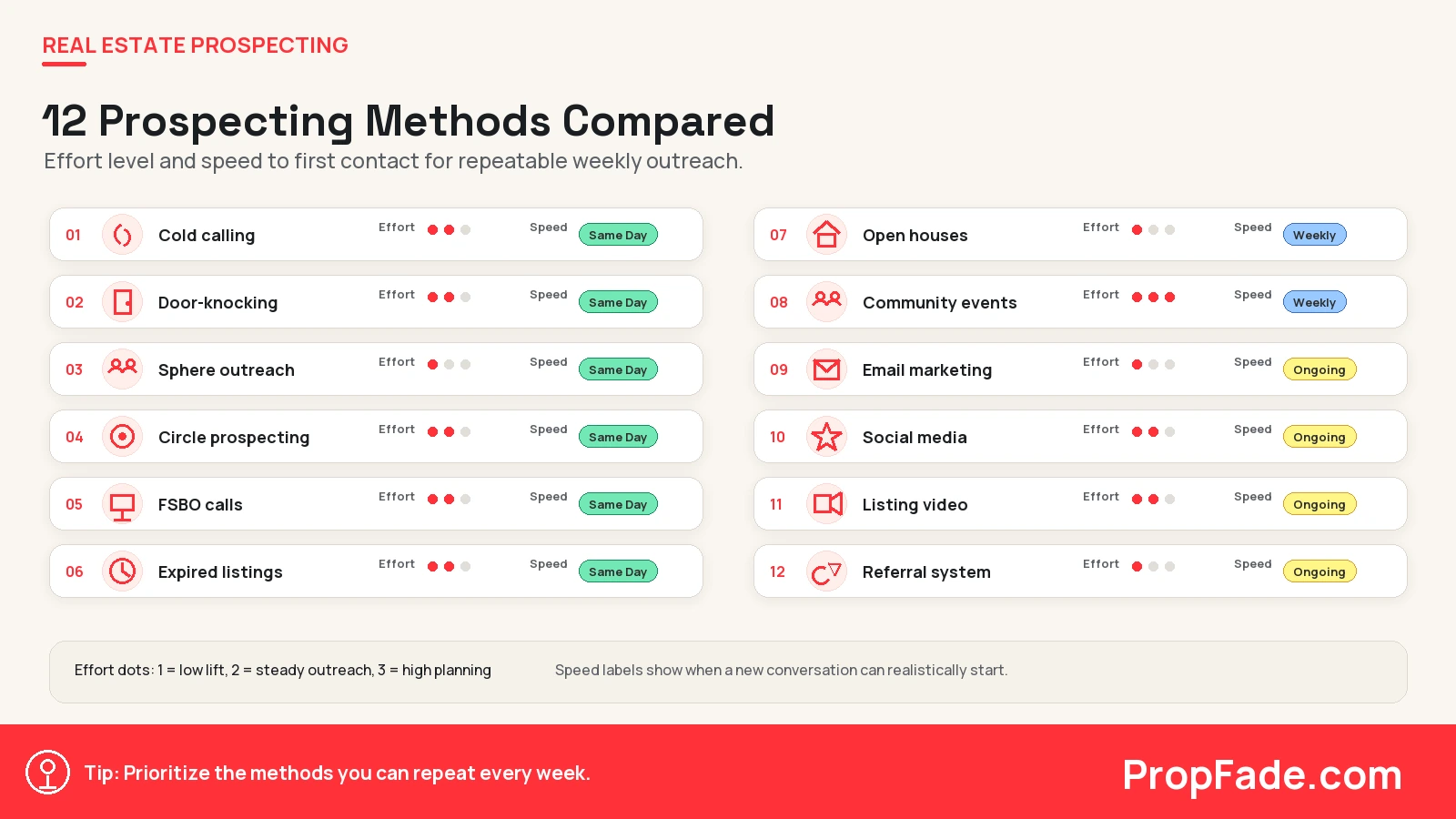
| Method | Effort | Speed to lead | Best for |
|---|---|---|---|
| Cold calling | Medium | Same day | Volume outreach |
| Door-knocking | Medium | Same day | Geographic farm |
| Sphere of influence | Low | Same day | New agents |
| Circle prospecting | Medium | Same day | Active farm areas |
| FSBO outreach | Medium | Same day | Conversion-focused agents |
| Expired listings | Medium | Same day | Script-confident agents |
| Open houses | Low | Weekend | Passive lead capture |
| Community events | High | Weekly | Deep relationships |
| Email marketing | Low | Ongoing | Database nurture |
| Social media | Medium | Ongoing | Brand visibility |
| Listing video | Medium | Ongoing | Visual prospecting |
| Referral system | Low | Ongoing | Long-term pipeline |
Cold calling
Cold calling means dialing property owners in a defined farm area, a purchased lead list, or a segment of your existing CRM. A focused two-hour morning session reaches 40 to 60 contacts and surfaces two to four open conversations. Keep the script short: introduce yourself, cite a specific recent neighborhood sale as your reason for calling, and ask one open question about their plans.
The more targeted the list, the higher the conversion rate. Calling owners who have lived in the same home for seven or more years yields more seller conversations than a broad zip-code pull, because long-term owners are statistically closer to a move.
Door-knocking
Door-knocking puts you in front of homeowners in person, removing the friction of a phone call going unanswered. Work a consistent route of 25 to 40 homes in your farm zone, log every response in your CRM, and return to the same route each month. Owners who see a familiar face at the door begin to associate your name with the neighborhood rather than treat you as a cold pitch.
Bring a one-page printed market report as a leave-behind. A tangible piece with current sold prices stays on the kitchen counter longer than a business card.
Sphere of influence
Your sphere of influence (SOI) is made up of past clients, family, friends, neighbors, and former colleagues. According to NAR’s 2024 Profile of Home Buyers and Sellers, 38 percent of sellers found their agent through a referral from a friend, neighbor, or relative. A monthly market update email or text to your SOI keeps you top of mind at almost no cost per contact.
A polished real estate bio and a set of memorable real estate slogans make it easy for SOI contacts to describe you accurately when they pass your name along.
Circle prospecting
Circle prospecting means contacting homeowners within a defined radius around a property you just listed or sold. A radius of 50 to 200 homes gives you a direct reason to call: a home on the same street just sold, and buyers who lost that one are still searching. Work the same circle on every listing and closing, and neighbors connect your name with recent results in the neighborhood.
The script is one sentence: name the street, name the outcome, and ask if they have considered what their own home might bring in the current market.
FSBO outreach
For-sale-by-owner sellers are in the market and motivated. NAR’s 2024 Profile of Home Buyers and Sellers shows FSBOs accounted for 6 percent of home sales, and many of those sellers found pricing, marketing, and negotiation harder than expected. Approach each FSBO with a specific offer of value, such as a free comparative market analysis or a professional listing video, rather than an immediate pitch to list.
Calling the same FSBO three times over the first two weeks, spaced several days apart, captures sellers who were not ready on the first contact but ran into trouble since.
Expired listing calls
An expired listing signals a motivated seller whose prior marketing plan fell short. Call within 24 hours of expiration, because the window before other agents reach the same lead is narrow. Lead with empathy and specific improvement ideas: better photography, a broader price range, and a listing video that distributes to social media before the property hits the MLS.
Script the first call around the question “What do you think held back the sale?” rather than a pitch. Sellers who feel heard are more open to a second conversation.
Open houses
An open house brings buyers to you, but neighbors stop by too, and a curious neighbor is often six to eighteen months from listing. Set up a sign-in sheet with a simple market report as the incentive to sign, then follow up every attendee within 24 hours. A focused four-hour open house in an active neighborhood generates five to fifteen new contacts, many of whom are local owners paying close attention to prices.
Community events
Hosting or sponsoring a first-time-buyer workshop, a neighborhood happy hour, or a quarterly market-update breakfast positions you as a local resource. Events take more planning than a call list but produce higher-quality introductions because attendees choose to engage. A 20-person market breakfast costs a few hundred dollars and generates introductions that a cold call cannot replicate.
Email marketing
A bi-weekly or monthly newsletter keeps your name in front of your entire database with minimal per-contact cost. Write one market stat, link to a recent listing or sale, and include one clear call to action such as a link to schedule a consultation. Segment by buyer, seller, and past client so each group receives content relevant to their situation.
Social media prospecting
Consistent posting on Instagram, Facebook, and LinkedIn builds a visible presence in your farm market before a lead ever calls. Listing photos, short neighborhood videos, and market-stats graphics are the three content formats that earn the most engagement on agent accounts. Posting three to five times per week and replying to comments within the first hour signals to the algorithm to push the content to more local viewers.
Social media videos for real estate covers which video formats earn the most reach per platform and how to batch a full week of content in one sitting.
A searchable, consistent handle starts with the right name. A real estate branding guide builds options from your name, market, and specialty.
Listing video prospecting
A listing video distributed on social media reaches buyers and neighbors who may be thinking about selling. A slideshow video editor renders three video formats from a set of listing photos: a 9:16 cut for Reels and TikTok, a 1:1 cut for the feed, and a 16:9 cut for the listing page and YouTube. Each video carries your branding and lands in front of people outside your current call list.
Agents who post a listing video on every new property build a recognizable content presence in their market within two to three months. For the full strategy behind which video types drive the most prospecting conversations, see real estate video marketing.
Referral system
A referral system converts past clients into an active source of new business over time. Ask for the referral at three points: at close, at the 30-day check-in call, and at the annual home-value update. A handwritten note and a small closing gift at each stage keep the relationship warm long after the transaction ends.
NAR data shows 38 percent of buyers also found their agent through a referral from a friend or family member, confirming the referral system as the highest-returning prospecting channel per hour of effort. Every past client is a potential source of two to three future transactions over a five-year period.
Build a daily real estate prospecting plan
A productive daily prospecting plan blocks two to three hours of uninterrupted outreach each morning before administrative tasks fill the calendar. The plan has four parts: a call block, a follow-up block, an in-person or content block, and a short pipeline review.
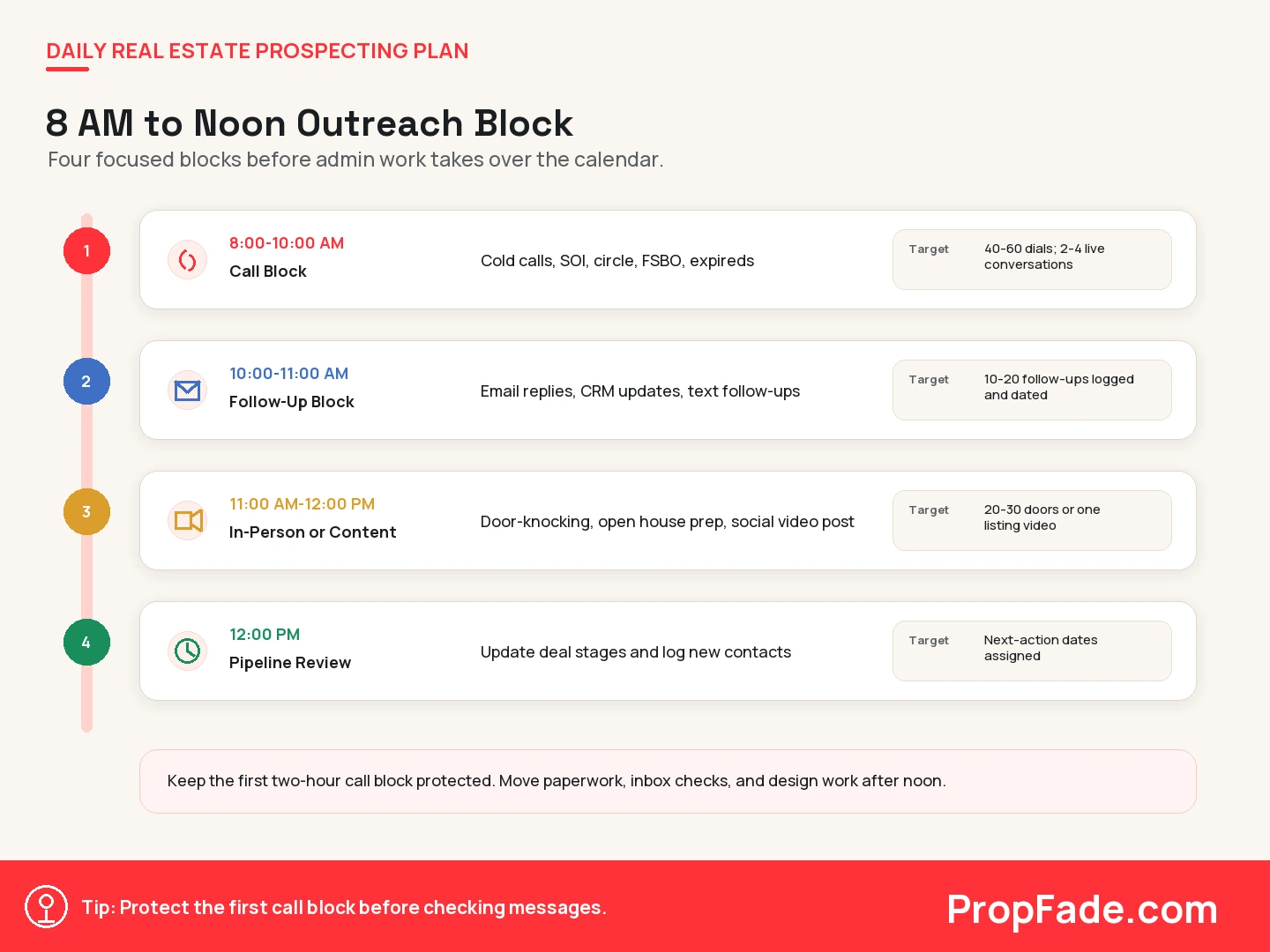
| Time block | Activity | Target output |
|---|---|---|
| 8:00 to 10:00 AM | Call block: cold calls, SOI, circle, FSBO, expireds | 40 to 60 dials, 2 to 4 live conversations |
| 10:00 to 11:00 AM | Follow-up: email replies, CRM updates, text responses | 10 to 20 follow-ups logged and dated |
| 11:00 AM to 12:00 PM | In-person or content: door-knocking, open house, social post | 20 to 30 doors or one published listing video |
| 12:00 PM | Pipeline review: update stages, add new names | Pipeline current with next-action dates |
Morning call block: 8 to 10 AM
The first two hours of the workday are the most productive prospecting window. Most homeowners are reachable before they leave for work, and fewer distractions compete with the calls. Use a printed or CRM-built list of 60 to 80 names and track every outcome: reached, voicemail left, no answer, or callback requested. Two hours of focused dialing produces more pipeline movement than four hours of interrupted calling spread across the day.
Rotate your call list each week: one day for SOI contacts, one day for cold farm calls, one day for circle prospecting, and one day for FSBO and expired leads. Variety keeps the calls fresh and covers every lead source within the week.
Follow-up block: 10 to 11 AM
Follow-up converts initial contacts into appointments. Work through email replies, text-back requests, and CRM tasks flagged from previous days. Update the last-contact date for every name you reached during the call block, because a prospect whose contact date goes stale disappears from most CRM views and falls out of the active pipeline.
A consistent follow-up cadence matters as much as the first call. Most prospects need seven to twelve touches before scheduling an appointment, so a single unanswered call is a data point, not a dead lead.
In-person or content block: 11 AM to noon
This block covers any activity that requires leaving the desk or publishing content online. Door-knock a 30-home route two or three times per week, or batch and schedule the week’s social media posts and listing videos on a single morning. Creating a week’s worth of listing video content in one sitting takes a consistent format: drop the photos into your slideshow editor template, confirm the listing facts in the captions, export three cuts, and schedule them across platforms.
Alternating door-knocking days with content creation days means the pipeline receives both in-person contacts and digital impressions each week.
End-of-day pipeline review
A five-minute pipeline review closes the prospecting loop for the day. Move every new contact into the correct CRM stage, assign a next-action date, and count new names added. Agents who run a daily pipeline review add three to five qualified new contacts per week on average, which compounds into a database of several hundred active prospects within the first year.
Track and convert your real estate prospects
Tracking converts prospecting effort into a measurable pipeline. Set a defined follow-up cadence for each prospect type and update the CRM after every contact so the next step is always visible.
Suggested cadences by lead type:
- Warm SOI contact: monthly market update, quarterly personal call
- Cold call (expressed interest): 3-day callback, 2-week check-in, monthly touch after that
- FSBO or expired: three contacts in the first week, then monthly
- Open house attendee: same-day thank-you, 48-hour follow-up, 30-day check-in
Measure three numbers at the end of each week: new contacts added, follow-up conversations completed, and appointments scheduled. Those three metrics show exactly where the pipeline is stalling and which prospecting method is producing the most traction.
A consistent brand across every touchpoint makes each contact stickier. A strong real estate bio and a consistent set of real estate slogans help prospects recall your name and your value between contacts, especially when they encounter your listing videos and social posts in the days after a call.
Frequently asked questions
Real estate prospecting is the practice of identifying potential sellers and buyers and making consistent contact until they are ready to work with an agent. It includes cold calling, door-knocking, sphere of influence outreach, circle prospecting, social media, and listing video, among other methods.
The highest-returning methods per hour invested are sphere of influence outreach, referral systems, and circle prospecting around recent sales. Cold calling and door-knocking produce same-day contacts but require higher volume. Listing video and social media build a long-term pipeline with compounding visibility.
Most productive agents block two to three hours of uninterrupted prospecting time each morning. A two-hour call block produces 40 to 60 dials and two to four live conversations, which is enough to build a pipeline of five to ten new contacts per week.
Circle prospecting means contacting homeowners within 50 to 200 homes around a property you just listed or sold. It gives you a specific, current reason to call and positions you as the neighborhood expert. Agents who circle-prospect on every transaction build a recognized presence in their farm area within a few months.