
Real estate agents hand out hundreds of business cards a year, and each one stays in a contact’s wallet, drawer, or desk for months after the first meeting. A card with a clear headshot, a clean layout, and one strong call to action converts a casual introduction into a future listing appointment.
This guide delivers editable templates by style, a full list of what to include and what to cut, design ideas matched to agent niches, a print-service comparison, and the mistakes that force a costly reorder.
Real estate business card design ideas: layout, finish, QR codes, and brand
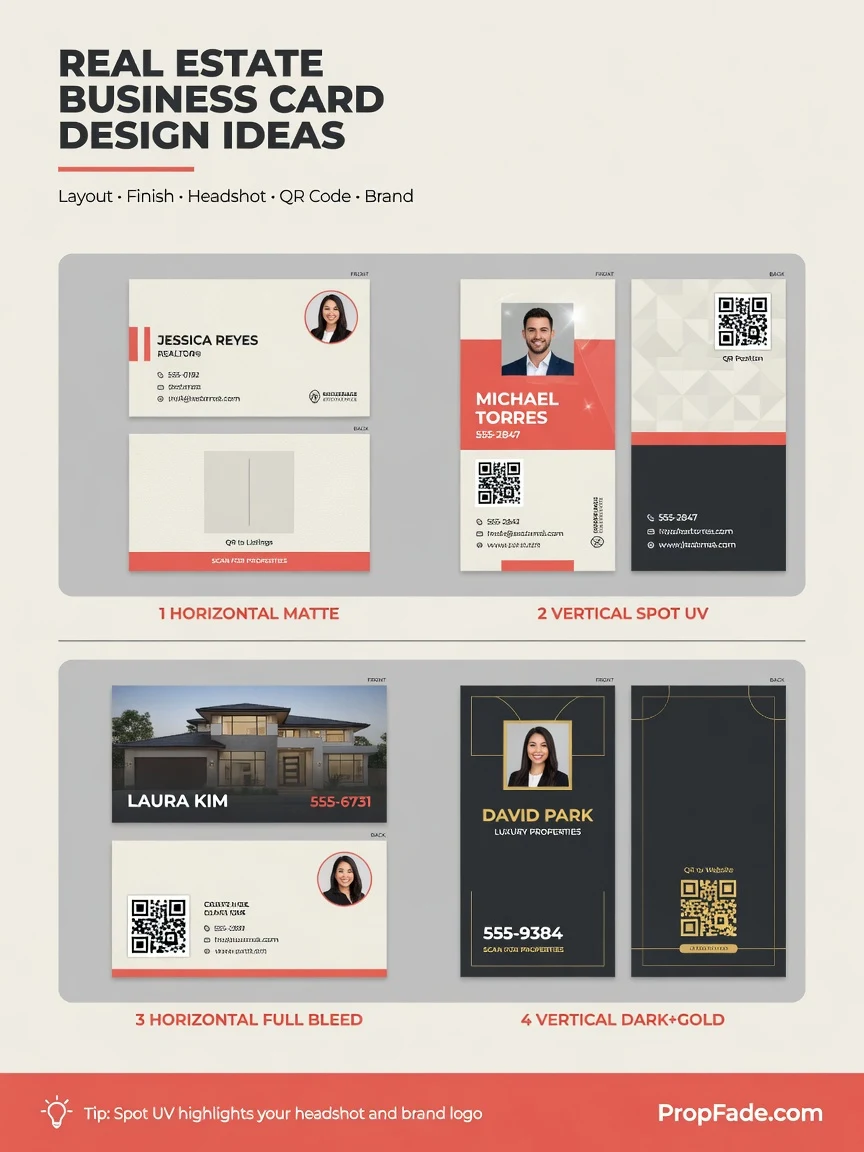
Six choices shape a real estate business card: layout orientation, finish type (matte, gloss, or spot UV), a headshot photo, brand colors, a brokerage logo, and a QR code linking to your listings or website.
Horizontal vs. vertical layout
Horizontal cards read naturally and fit wallets without rotating. Both orientations use the standard US card size of 3.5 × 2 inches (88.9 × 50.8 mm), so either fits a standard cardholder. Vertical cards stand out in a stacked pile and pair well with a full-bleed headshot running down one side.
Finish types: matte, gloss, and spot UV
Matte laminate gives a smooth, muted feel and lets contacts write on the back, which matters at open houses where buyers jot questions and prices. Gloss laminate makes colors and photos vivid but creates glare and resists pen ink. Spot UV, a clear raised coating applied over your name or logo only, adds a tactile premium quality signal that buyers notice when they pick up the card.
Headshot photo
A headshot on the front raises name recognition and buyer recall. Supply a cropped, professional photo with a neutral or on-brand background, and provide the file at 300 DPI minimum so the image prints sharp rather than pixelated.
QR code
A QR code turns a corner of the card into a live digital link. Route it to your active listings page, your agent website, or a digital contact card that buyers can save directly to their phones. Use a redirectable short URL so you can update the destination without reprinting.
Brand colors and logo
Pick one primary brand color and one neutral, then carry both across your card, your listing flyers, your real estate slogans, and your social templates. Consistency across print and digital assets builds recognition faster than any single design element.
Editable real estate business card templates by style
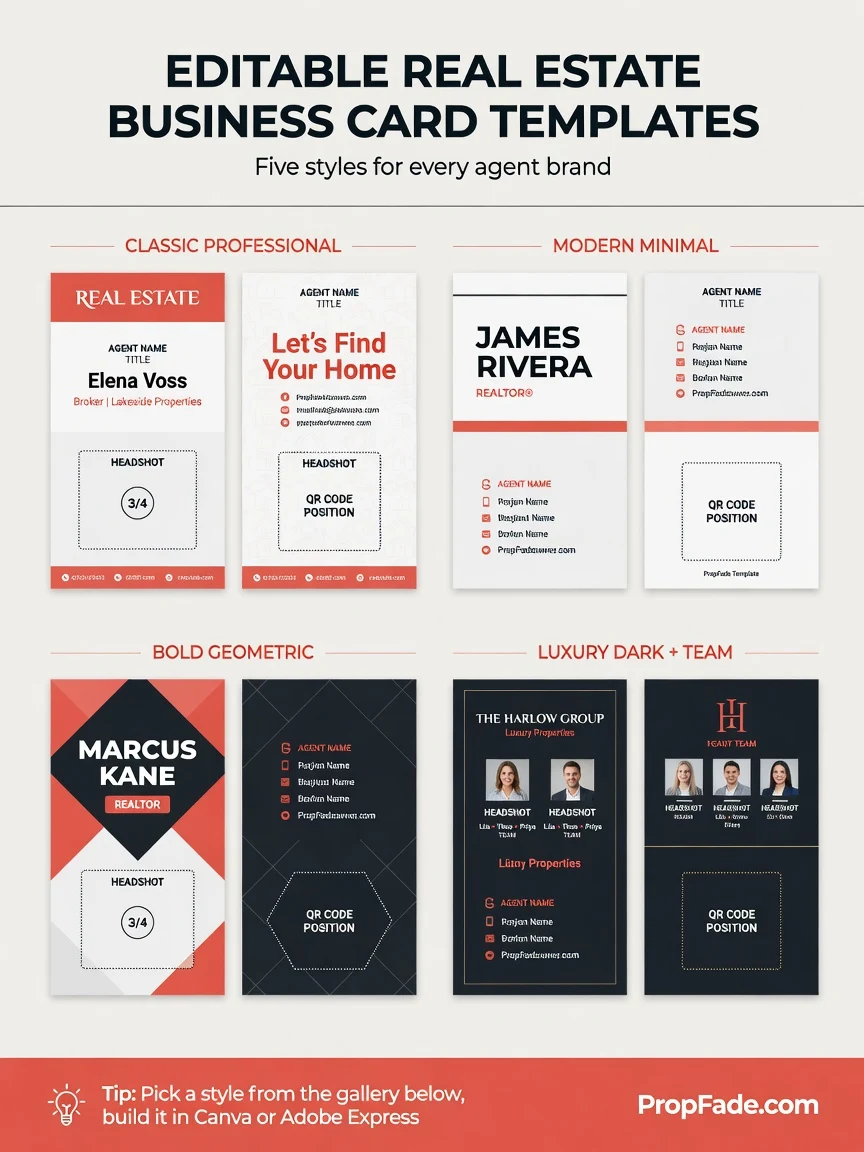
Editable templates come in five styles suited to different agent brands: classic professional, modern minimal, bold geometric, luxury dark, and team cards. Pick a style from the gallery below, build it in Canva or Adobe Express, swap your name, headshot, phone, and brand colors once, and the layout stays consistent across every print run.
Classic professional
A clean serif or neutral sans-serif font, white or light gray background, headshot top-right, agent name in bold, brokerage logo small at the bottom. Reads clearly at the printed 3.5 × 2 inch size and works in any market segment. This is the most commonly printed real estate card style.
Modern minimal
One brand accent color, generous white space, a small personal monogram or logo, and the name in a strong geometric typeface. No tagline, no secondary information competing for attention. The restraint signals confidence.
Bold geometric
A solid color block behind the headshot, name reversed in white, one icon or brand mark at the corner. Stands out in a pile of cards at a broker preview or a neighborhood open house table.
Luxury dark
Matte black or deep navy stock with gold foil or white ink for the name and phone number. Works best with a studio-lit headshot and a minimal text layout. Suited to agents working in high-end residential segments where the card itself communicates the quality tier.
Team card
Team name and logo on the front. Individual agent name and direct line on the back. Buyers know their point of contact immediately, and the design keeps brokerage branding and personal identity cleanly separated.
What to include on a real estate business card (and what to skip)
Every real estate business card needs five elements: your full name, your license designation, a direct mobile number, a professional email, and a website URL. A headshot and brokerage logo are strong additions, and the five core fields meet the advertising minimum in most states.
The five essentials
- Full name, spelled exactly as it appears in your license records
- License designation: REALTOR, licensed real estate agent, or broker, whichever applies to your license
- Direct mobile number, not a brokerage reception or shared office line
- Professional email on a personal or brokerage domain
- Website URL pointing to your agent site, your brokerage profile page, or a dedicated buyer or seller landing page
Consider adding
- Headshot photo (raises recall, especially after open houses where buyers meet multiple agents in one afternoon)
- Brokerage name and logo (required by many brokerage policies and some state real estate licensing boards)
- One social media handle, Instagram or LinkedIn, not all four platforms
- QR code linking to your active listings or a digital contact card
License number: confirm your state’s rules
Some states require agents to include their license number on all marketing materials, including business cards. Requirements vary by state, so confirm with your state’s real estate commission before printing a full run. The National Association of Realtors publishes ethics and advertising standards that govern REALTOR members, and your state commission is the primary authority for license-number disclosure rules in your market.
Skip these
- Fax numbers (no buyer or seller uses them in 2026)
- Multiple phone numbers (one direct mobile line is always clearer than two)
- The full brokerage street address (wastes print space and gives buyers no useful information at a first encounter)
- A vague personal tagline that answers no buyer question, such as “passionate about people” or “your trusted resource”
Build a real estate bio that carries your story and credentials so the card stays lean and functional. If your bio needs a full rewrite, the real estate bio template gives you a structured starting point.
Real estate business card picks by agent type and niche
Match the card to your market position. New agents, luxury specialists, team leaders, and farm-area agents each have a different priority within the 3.5 × 2 inch card space.
New real estate agent
Lean on brokerage branding while your personal recognition is still building. Use a clear professional headshot, keep the layout simple, and add a QR code that routes to your brokerage profile page so buyers can verify your credentials in seconds. The brokerage name carries the trust; your headshot carries the introduction.
Luxury market specialist
Invest in 32-point stock with matte laminate or spot UV coating. Minimal text, a studio-lit headshot, and one accent color in gold or deep charcoal signal the quality tier before a buyer reads your name. Print runs can be smaller (250 cards rather than 500) because per-card quality matters more than volume at this price point.
Team leader or team member
A team card puts the team name and logo on the front with each agent’s name and direct line on the back. Consistent templates across all members create a unified brand identity, which is especially important when you are building the recognition value of a brand name buyers should search for and remember.
Farm area specialist
Put the neighborhood name or a local landmark photo on the front. A QR code linking to a hyper-local market report gives the card a reason to stay on the buyer’s desk. Pair the card with a real estate bio that explicitly names the zip codes and neighborhoods you specialize in.
For a complete personal-marketing plan that connects cards, postcards, social posts, and listing videos, the market yourself as a real estate agent guide maps how each channel reinforces the others.
Common real estate business card mistakes agents make
Four mistakes push agents into a costly early reorder: a blurry headshot from a low-resolution file, too many contact options crowding the face, a brokerage URL that wraps off the card margin, and a glossy finish buyers cannot write on at open houses.
Low-resolution photo
A headshot cropped from a phone camera roll or saved from a low-resolution web preview (72 DPI) prints as a blurry block. Request a print-ready file from your photographer at 300 DPI minimum. Most professional headshot sessions include a high-resolution export as a standard deliverable.
Too much information
Every element you add competes with your phone number, which is the one fact the buyer needs right now. Choose one phone, one email, and one URL. If you also include a social handle and a QR code, test the layout at the actual printed size before ordering.
Long, unmemorable URLs
A URL like yourbrokerage.com/agents/yourname/properties?ref=dashboard wraps across lines and is impossible to type from memory. Use a short personal domain such as yourname.com or a redirectable short link, so the destination stays current even after the cards print.
Wrong finish for the situation
Gloss laminate looks sharp in product photos, but buyers at open houses hold the card for an hour and write questions on the back. Matte or soft-touch stock handles both situations.
Ordering too few cards at once
Agents active at open houses, broker previews, and community events go through cards faster than expected. Printing 500 cards at a time costs less per card than two orders of 250 and removes the risk of running out mid-event.
Outdated information
A card that lists a former brokerage name, a disconnected phone number, or a changed website URL erodes trust faster than no card at all. Review your print file every time you change firms, phone providers, or website platforms.
For parallel print marketing that complements the card, the real estate postcards guide covers design, list targeting, and direct-mail strategy that works alongside a card handoff.
Where to print real estate business cards: options and comparison
Four print services cover most agent needs. Each suits a different priority: premium stock, bulk volume, fast turnaround, or design-tool integration.
| Printer | Stock and finish options | Typical turnaround | Best for |
|---|---|---|---|
| Moo | Premium stocks, Printfinity (different image on each card back), spot gloss, soft-touch matte | 5 to 7 business days standard | Agents who want standout paper stock and a unique image per card back |
| Vistaprint | Wide stock range including soft-touch matte, in-browser design tools, bulk quantity options | 3 to 5 business days expedited | High-volume reorders and agents who prefer an online design editor |
| GotPrint | Offset and digital printing, matte and gloss laminate, rush print options | 1 to 3 business days rush | Agents who need cards within 48 hours before a broker preview or listing event |
| Canva Print | Glossy, matte, and thick card stocks, direct integration with the Canva design editor | 5 to 7 business days standard | Agents who designed their card in Canva and want a one-click upload to print |
Order a paper sample kit from your chosen service before committing to a full run. Paper weight, finish texture, and color rendering vary between printers, and a small sample costs a few dollars versus the expense of reprinting 500 cards.
Most agents start with standard 14-point or 16-point card stock, which is sturdy and professional. A 32-point ultra-thick card is worth the step up for luxury-market agents or any situation where the physical weight of the card should signal premium positioning.
The National Association of Realtors, the largest real estate trade association in the United States with more than one million members, publishes advertising standards and ethics guidelines that REALTOR members follow when producing and distributing marketing materials including business cards. Confirm any disclosure requirements with NAR’s standards and your state’s real estate commission.
Frequently asked questions
Include your full name, license designation (REALTOR, agent, or broker), one direct mobile number, a professional email, and a website URL. A headshot and brokerage logo are strong additions. Some states require a license number on all marketing materials, so confirm with your state real estate commission before printing.
Use the five-style gallery above as your starting structure and build the card in Canva, Adobe Express, or your brokerage's approved design tools. Print services including Moo, Vistaprint, GotPrint, and Canva Print each offer built-in template libraries and accept uploaded design files.
A good realtor business card has a sharp headshot at 300 DPI or higher, one direct phone number, one email address, and a short website URL. Choose a finish that fits the use case: matte for events where buyers write on the back, and spot UV or thick stock for luxury market positioning.